How AI Agents Are Revolutionizing Business Automation
 Admin
Admin

How AI Agents Are Revolutionizing Business Automation
Admin
Today, the workplace is overwhelmed with repetitive tasks. Tasks like emails, data entry, coordinating meetings, and preparing standard reports. These mindless tasks suck away a skilled professional’s time and often take them away from their actual work of true value. By now you’ve probably heard of an AI agent making sense in the workplace.
AI agents automating administrative tasks are intelligent systems that use AI technologies to take care of routine administrative processes quickly, accurately, and adaptably. They function in the background, handling regular activities so that teams working behind the scenes can focus on what makes their business tick. AI agents are NOT just simple bots—they are designed to understand routine management processes like coordinating a meeting and replying to emails, with the intent of freeing people from mundane, repetitive tasks. As businesses adopt advanced AI software development services like those offered at Code Curators, organizations are now looking to scale, optimize resources, and achieve efficiencies across the rest of their operations.
Let’s see the change administration went through AI agents in various industries, and how they free up time when organizations run smarter rather than harder. If you still work manually, not through workflow solutions for your business, right now is the time to see how the AI administrative revolution in businesses is freeing up people every day and how it is going to redefine productivity.
What Are AI Agents and How Do They Work?
AI agents offer an advanced level of intelligent systems with the integration of the full range of AI technologies, such as natural language processing (NLP), machine learning (ML), and computer vision. Instead of doing it for a single task, an AI agent is capable of planning a whole workflow with minimal to no human involvement. There is a profound distinction between artificial intelligence and rule-based or traditional automation bots, whose main input comes from a structured set of rules and structured data. AI agents can understand and process natural language, learn from the past, and react in real-time to conditions as they arise. They can book appointments, write emails, extract text from documents, answer emails, hold conversations, or do tasks across many platforms and channels, never deviating from the defined business logic and policy.
Automating Common Administrative Tasks
AI agents automating administrative tasks like scheduling by monitoring calendar conflicts, setting appointments, and sending invitations is bringing a shift in business operations. They can produce written communication (messages, follow-ups, confirmations, etc.) without any human intervention.
Email Drafting and Replies: NLP-enabled agents can read and understand incoming emails, summarize the content, and create human-sounding replies.
Document Organization: AI can classify, tag, and store documents quickly and efficiently, whether in digital formats or converted from a piece of paper
Dashboard Updates: Real-time updates can be automatically pushed to a shared dashboard to keep all stakeholders informed
Report Creation: Reports can be designed to be created after a specific event or at specified time intervals, resulting in less need for human interaction.

Small Business Appointment Management
A small business has a very low-cost AI agent to accept all scheduling requests with minimal hassle. Using AI agents for repetitive office tasks like checking calendar availability, booking meetings, sending reminders, and even automatically rescheduling when conflicts arise. It reduces the back-and-forth phone calls or emails to schedule appointments, eliminates appointments missed entirely, and makes the task of scheduling collective space as easily as possible.
Seamless Integration with Existing Tools
AI agents can easily integrate into popular platforms like Google Workspace, Microsoft 365, and popular CRMs. They can pull data out of sheets, update real-time records, and send stakeholders a summary report, without any request. They have also established monitoring of the overall metrics and will send alerts immediately when changes are substantial. Teams stay informed and can react in a much shorter time to delivery.
Using Natural Language Processing (NLP)
Natural Language Processing (NLP) allows artificial intelligence agents to respond to emails or chat messages while sounding natural and human-like. NLP can be used to distill long threads of message into digestible, actionable points or automatically generate standard responses to similar questions by relying on context clues. Respondents can use NLP to enhance internal communications and increase efficiency when communicating with customer support.
Integrated with Communication Platforms
AI agents interface with communication platforms such as Slack, Microsoft Teams, and Zoom to improve collaboration. Within these channels, AI agents can post meeting notes, assign team member to-dos, and set reminders allowing teams to stay organized and executed without manual intervention.
Real-World Applications Across Departments
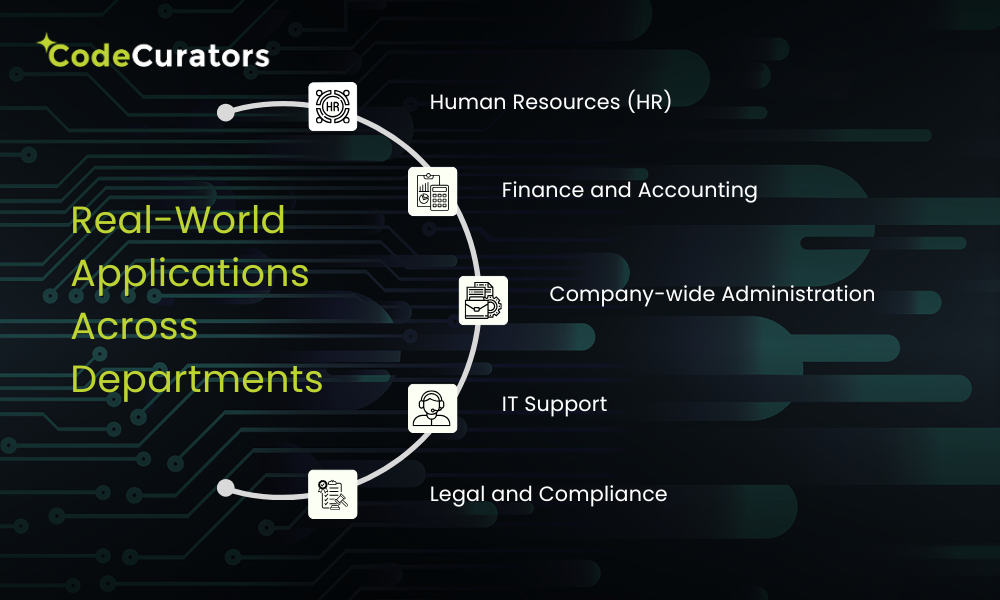
AI agents are no longer experimental—they are actively reshaping functions across departments. Let’s explore their role in key business areas:
Human Resources (HR)
HR uses AI agents to manage several plain but important tasks:
- Onboarding paperwork
- Interview scheduling
- Policy updates
- Employee questions
By automating these tedious tasks, HR professionals have more time to devote to engagement, equity, inclusion, and talent management initiatives. They won’t have to perform manual steps to coordinate an interview or repeatedly follow up to ensure the onboarding paperwork was submitted.
Finance and Accounting
For finance teams, there may be no greater benefit than AI automation:
- Matching purchase orders to invoices
- Reporting on financials
- Expense reimbursement processing
- Anomaly or discrepancy detection
Using AI agents streamlines steps, lines, and creates efficiencies in compliance and reduces human error risk. This allows finance professionals to spend more time on budgets, forecasting, and strategy.
Company-wide Administration
Tasks in an administrative function always take longer, with different teams – procurement, compliance, internal communications – for broadly defined business processes:
- No-touch workflows for progressing workflows against approvals.
- No-touch alerts when governance issues are occurring.
By taking many operations and re-flowing them as one manual operation, you have an improved decision-making process, and quicker time-to-execute.
IT Support
AI agents in IT departments handle tasks like:
- Triaging and routing support tickets
- Re-setting passwords
- Provisioning devices
This lowers help desk workload, delivers faster response times, and allows IT teams to spend more time with their thinking hats on doing things like protecting the organization’s network from data breaches, service architecture, and digital transformation.
Legal and Compliance
AI can assist legal departments in areas like:
- Drafting standard contracts (for instance, NDAs)
- Reviewing documents to assess risk exposure
- Automating approval workflows
Because AI applications can eliminate repetitive document review and document creation, legal practitioners can direct their attention more toward high-value advising and compliance strategy.
Autonomous AI Agents vs. Traditional Bots
The difference between rule-based bots and autonomous AI agents is quite vast. Bots are programmed using simple “if-this-then-that” rules, while AI agents:
Operational Logic
- Rule-based Bots: Follow predetermined “if-this-then-that” rules.
- AI Agents: Are operating using advanced logic and ML, meaning they can intelligently make decisions for themselves.
Data Interpretation
- Rule-based Bots: Have difficulty interpretting unstructured or unpredicatable data.
- AI Agents: Are able to understand and interpret unstructured inputs (e.g. emails, documents, messages, etc.).
Adaptability
- Rule-based Bots: If the input changes or does not match the predetermined rules, they fail.
- AI Agents: Can adapt to new situations and respond to them without the need for reprogramming.
Workflow Management
- Rule-based Bots: Manage one step or task at a time.
- AI Agents: Manage entire workflows end-to-end, triggering actions, coordinating systems, and updating stakeholders.
Learning Capability
- Rule-based Bots: Cannot learn or improve over time.
- AI Agents: Are always learning from the data and interactions they have to increase accuracy and efficiency.
Decision-making
- Rule-based Bots: Are limited to reacting to a binary choice with no context.
- AI Agents: Make decisions based on patterns, context and behavioral insights.
Example: Procurement Workflow Management
An autonomous agent handles a purchase request end-to-end. It verifies budget limits, selects approved vendors, sends RFQs, and follows up—all automatically. It also updates procurement records and notifies stakeholders, eliminating manual steps. This showcases how autonomous agents streamline complex workflows with minimal to no human intervention.
Key Technologies Powering AI Agents

Machine Learning for Continuous Learning
AI agents can learn from historical user data to find common patterns, improving their decision-making process and evolving their adaptive pattern recognition over time. This process creates a continuous learning loop that improves accuracy and efficiency, creating more efficiency and reliability when completing administrative tasks through automation the longer they are used.
Advanced Input Recognition
Computer vision allows AI agents to scan receipts, ID cards, and invoices, and learn what these are supposed to look like. The agent can then assess what to do and action it for tasks! Voice, through dictation opportunities, allows users to dictate notes or commands which are turned into actions by the agent. These advanced input recognitions will vastly increase the efficiency and flexibility of autonomous AI agents in an office or administrative work setting.
Inherent Security and Compliance
Autonomous AI agents will have role-based access controls required to limit sensitive actions to specific users when needed. They can also build the data retention policies and compliance programmed into their logic and assess if all actions adhered to company policy and security protocols, making autonomous AI Agents safe and reliable for enterprise compliance.
Natural Language Processing (NLP)
NLP allows an AI agent to comprehend human language, determine its meaning, and generate contextually relevant responses. This is essential to enabling automated email replies, summarizing long email threads, and improving chatbot responses.
Computer Vision
Computer vision allows AI to visualize input like scanned documents, receipts, and ID cards. Agents can pull out details, classify documents, and even flag fraudulent entries based on visual patterns.
Voice Recognition
Voice also provides a way of input – users can make notes or write command, and AI agents will turn those into tasks. this is helpful for both executives and remote workers.
AI Agents Freeing Up Skilled Workers
The AI agent market in the U.S. generated $1.6 billion in 2024, and it’s expected to grow to $13.5 billion by 2030 at a CAGR of 43.3%. Much of this growth is being driven by the explosion in demand for AI-powered automation across a variety of industries, including finance, healthcare, and retail.
- Marketers to spend their time on creative strategy rather than manually tracking competitor activities.
- Salespeople to focus on their relationships with clients, while AI manages their CRM entries and follow-ups.
- Legal professionals to spend their time considering strategic analysis instead of reformatting contracts.
This does not replace jobs – this enhances jobs. People’s satisfaction increases, burnout goes down and they access better planning opportunities than before.
Building the Future: AI Agents and Workforce Transformation
Empowering flexibility in the workforce
As remote and hybrid work becomes the new normal, AI agents will ensure seamless collaboration, the execution of tasks, and communication among members of a team dispersed across various locations, allowing organizations to maintain some consistency no matter where their employees are located.
More efficient onboarding
AI agents can automate the orientation process, complete required HR paperwork, and provide role-specific training content to new hires. This leads to shorter onboarding timelines, less reliance on HR resources, and new hires become productive as soon as they join an organization.
Operations that scale without increasing employee headcount
Businesses can scale and grow effectively without growing their teams proportionately. AI agents can take on growing workloads that would otherwise drop on an employee’s desk by completing repeatable, low-value administrative tasks – allowing employees to focus on the high-value work.
Reduced costs and fewer employees
Automation will reduce the need for overtime, contracted staff or temporary hires. Also, with fewer manual tasks, there will be fewer errors requiring rework, meaning direct savings and better allocations of resources.
Always-on productivity
AI agents work tirelessly 7 days a week, 24 hours a day enabling effortless workflows. Call logging, data entry, meeting coordination, and report-writing will all continue after the close of business hours to increase output and responsiveness.
Future-proofing the workforce
Companies today that adopt AI agents for their tasks, will be better positioned to compete in an increasingly automated economy tomorrow. They will have the first mover advantage through increased productivity, innovation and adaptability that will benefit their businesses.
Transforming Workforce Strategically
AI agents don’t eliminate people, but elevate them, and do the ‘heavy lifting’ even before they ever become workers so that gifted and talented workers can focus on creativity, strategy, and growth initiatives.
Adoption of AI agents is the first in a series of steps that lead to sustainable growth, reducing operational costs, and developing a workforce ready to flourish in an AI-powered future.
Conclusion
Administrative task automation powered by AI agents is changing the way we work and changing the nature of work by streamlining operations and increasing efficiency across departments. Importantly, AI doesn’t replace jobs, it liberates knowledge workers from transactional grunt work, allowing them to focus on what we love: creativity, strategy, authentic collaboration, and innovation. Every organization ought to take stock of what is inefficient or excessive in its current processes and consider piloting AI tools to reduce the time staff spends on repetitive tasks.
In the long run, the benefits of improved accuracy, shorter workflow time, higher productivity, and higher employee engagement arguments are too compelling to overlook. As we increasingly move further into a future defined by collaboration with AI, organizations that begin adapting sooner rather than later will be the leaders in the class of 2030. In an AI-augmented future, time may become the most valuable resource of all.