

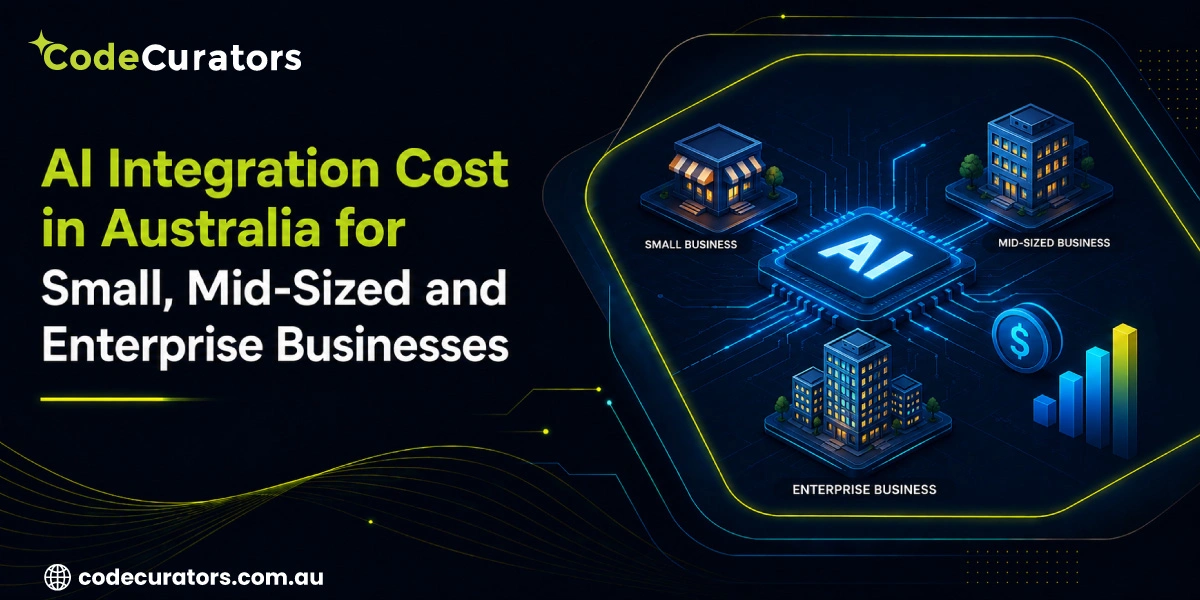
AI integration is the method of integrating AI technologies with existing business systems, apps & workflows. It automates tasks, enhances decision-making skills & workflow productivity. AI integration services support firms in implementing AI solutions without replacing their existing infrastructure and allow seamless data flow.
PwC reports in 2026 revealed that 73% of Australian firms have implemented robust AI security measures. Australian firms now use AI to automate support, measure data, enhance forecasting and personalise marketing. It is helpful for businesses to enhance productivity, customer experience, and reduce operational costs. From the retail industry to manufacturing, firms are using AI to automate repetitive processes, measure large datasets, and deliver data-driven decisions.
Before integrating advanced AI integration services, firms must clearly understand their integration goals. Measure current systems, data quality, security standards, and scalability to ensure the AI solutions align with operational tasks. Identify integration challenges early to minimise deployment risks, implementation costs, and uplift long-term performance. An organised strategy ensures seamless implementation, drives ROI, and allows firms to scale AI potential as the firm evolves.
The integration cost depends on what you are trying to obtain, how mature your data is, and whether the engagement is scoped properly. The AI integration cost in Australia ranges from AUD $5,000 for a small business workflow and AUD $1,000,000+ for a complex enterprise business. Here we have mentioned the factors that influence the AI integration cost in Australia.
Factors That Influence AI Integration Cost in Australia
◈ Type of AI Solution
One of the biggest elements that influences custom AI integration services cost in Australia is the kind of AI solution you select. The advanced AI solutions necessitate larger investments in development, infrastructure, and continuous optimisation. However, simple AI applications with predefined capabilities are typically quicker and less expensive to implement.
Before choosing an AI solution, businesses should assess their operational objectives, scalability needs, data accessibility, and current technological environment. Selecting the appropriate solution guarantees improved performance, reduced implementation risks, and a higher long-term return on investment.
➛ How it impacts cost:
Development effort, infrastructure requirements, implementation schedules, and total project costs are all directly impacted by the complexity, functionality, deployment model, and level of customisation needed.
➛ Cost Impact Factors:
• Generative AI applications: Need more advanced AI models, the ability to create content, and more processing power.
• Machine learning models: The amount of data, model training, accuracy requirements, and ongoing optimisation all affect costs.
• AI-powered automation systems: The complexity of development and implementation is increased when AI is integrated across various workflows.
• Chatbots and virtual assistants: The cost of chatbots and virtual assistants varies according to the intricacy of the conversation, support for multiple languages, integrations, and unique features.
◈ Business Requirements and Project Scope
Project scope is one of the key elements affecting AI integration costs because every company has different goals, operational procedures, and technology needs. An enterprise-wide deployment involving numerous business units and intricate workflows is typically more expensive than a small AI implementation targeted at a single department.
The amount of work needed for development, system integration, testing, and deployment depends on the project’s scope. Organisations can efficiently allocate budgets while lowering unnecessary expenses and implementation risks by clearly defining business goals, implementation priorities, and expected outcomes.
➛ How it impacts cost:
The cost of implementation increases with project scope. To ensure seamless adoption, AI projects involving numerous systems, departments, and unique workflows need more development time, integration, testing, and change management.
➛ Cost Impact Factors:
• Number of processes to automate – Development, integration, and testing efforts are increased when more business processes are automated.
• Business workflow complexity – More configuration and validation are needed for highly customised workflows, which extend project timelines.
• Number of departments involved – Implementing AI across multiple departments necessitates more coordination, data integration, staff training, and continuous support, which raises overall costs.
Also Read: AI Integration Strategy Consulting: A Complete Guide for Business Leaders
◈ Data Availability and Quality
The quality and accessibility of data are important factors in determining the cost of integration charged by an AI integration service provider. When AI systems are trained with precise, comprehensive, and organised data, they perform at their best. Before implementing AI, businesses with inconsistent, out-of-date, or fragmented data frequently need more time and resources for data collection, cleaning, preparation, and migration.
Project schedules and expenses are directly impacted by elements like data accuracy, accessibility, governance, and system integration. AI performance, decision-making, and the need for expensive post-deployment rework are all improved by high-quality data.
➛ How it impacts cost:
The time and resources required for preparation are increased by poor-quality or disconnected data, which slows down implementation and raises project expenses.
➛ Cost Impact Factors:
• Data collection requirements – More integration work is needed to collect data from various business systems.
• Data cleaning and preparation – AI accuracy is increased by eliminating duplicates, fixing mistakes, and organising datasets.
• Data migration – Implementation complexity increases when data is safely transferred from outdated systems to modern AI platforms.
◈ Existing Technology Infrastructure
The cost of integrating AI is largely determined by the current technological infrastructure. Businesses can integrate AI more quickly and affordably if they have scalable databases, well-documented APIs, and modern cloud-based platforms. On the other hand, before hiring a generative AI integration agency, companies that use their legacy systems frequently need to upgrade their infrastructure.
Implementation time, development effort, and total project costs are directly impacted by elements like system compatibility, cloud readiness, database architecture, and API availability. Long-term AI scalability is supported, and integration difficulties are lessened with a solid technological foundation.
➛ How it impacts cost:
Development effort, integration complexity, and deployment schedules are directly impacted by current software compatibility, infrastructure availability, and system connectivity.
➛ Cost Impact Factors:
• Current software ecosystem – Integration effort is impacted by compatibility with current business applications.
• Cloud infrastructure – Environments prepared for the cloud lower deployment and scalability expenses.
• Database systems – Before integrating AI, older databases might need to be upgraded or reorganised.
• API availability – Well-designed APIs speed up development and make data exchange easier.
◈ Level of AI Customisation
One important factor affecting integration costs is the degree of AI customisation. Companies can decide between fully customised AI solutions made to satisfy particular operational and industry requirements or ready-to-use AI platforms for quicker deployment and lower costs.
Custom AI applications need more development, testing, integration, and continuous optimisation, whereas pre-built solutions can be implemented more quickly. The implementation effort and total investment increase with the degree to which the solution is customised to specific business processes. Cost, functionality, scalability, and long-term business value can all be balanced by choosing the appropriate degree of customisation.
➛ How it impacts cost:
Increased customisation raises implementation time and long-term maintenance costs because it necessitates specialised development, thorough testing, and ongoing improvements.
➛ Cost Impact Factors:
• Ready-to-use AI platforms – Faster deployment at lower implementation costs, but less flexibility.
• Customised AI solutions – More expensive to develop and designed to meet specific business needs.
• Industry-specific AI applications – These are made for specific use cases and frequently call for sophisticated integrations.
• Enterprise AI platforms – Large-scale operations are supported by enterprise AI platforms, which have more features, security, and scalability but come with higher implementation costs.
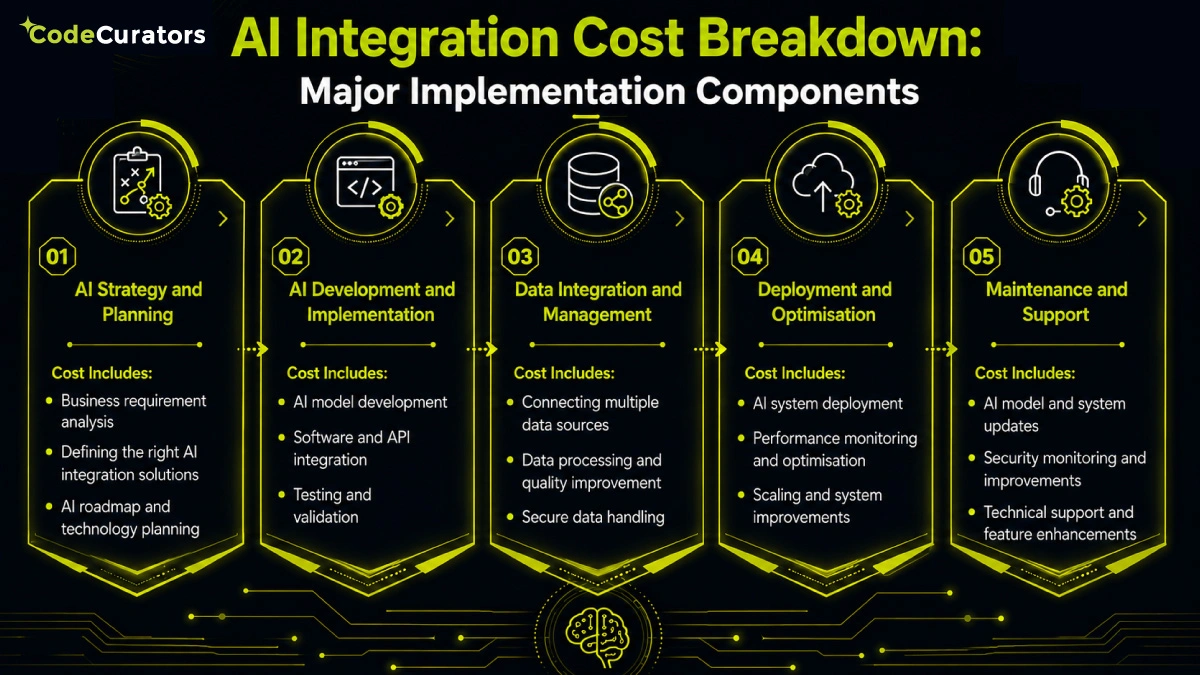
AI Integration Cost Breakdown: Major Implementation Components
✧ AI Strategy and Planning
Developing a clear strategy that is in line with business objectives is the main focus of the first phase of AI implementation. At this point, expenses include analysing business needs, determining which processes can be automated, assessing current systems, and establishing project goals. In order to prioritise use cases, estimate budgets, and set implementation timelines, businesses also invest in the development of AI roadmaps.
Another important cost factor is selecting the appropriate platforms, technologies, and AI integration solutions, which hampers long-term performance and scalability. A well-designed approach to AI integration solutions lowers implementation risks and prevents needless costs. It guarantees that AI projects provide measurable business value while accelerating future expansion.
✧ AI Development and Implementation
The development and application of AI also determine the cost factor. In this stage, AI models are designed and trained, custom algorithms are created as needed, and AI capabilities are integrated with current business applications. Software integration, API configuration, workflow automation, and cross-system compatibility testing are examples of additional costs.
Before deployment, thorough testing and validation guarantee the AI solution operates precisely, securely, and consistently. Development costs are influenced by the AI model’s complexity and the number of integrations & personalisation required. Businesses can achieve greater accuracy, increased efficiency, and long-term operational success by investing in quality implementation.
✧ Data Integration and Management
Scalable, quality data is necessary for integrating AI successfully. To create a cohesive information ecosystem, businesses usually invest in connecting various internal and external data sources. Building secure data pipelines, creating automated data processing workflows, cleaning inconsistent datasets, eliminating duplicates, and enhancing overall data quality are among the expenses.
Implementation costs are also influenced by governance, secure data handling, and adherence to privacy laws. Organisations frequently invest significant resources in data preparation because AI models depend on precise and organised data for optimal performance. Robust data management and integration enhance AI precision, facilitate better decision-making, and guarantee reliable business results.
✧ Deployment and Optimisation
Businesses must pay for the implementation of AI systems in production environments after they are developed. This involves setting up on-premises or cloud infrastructure, integrating AI with ongoing business operations, and making sure deployment causes the least amount of disturbance. Performance monitoring, model optimisation, system enhancements, and fixing operational problems are examples of ongoing costs.
As the use of AI increases and business needs change, organisations may also invest in expanding infrastructure. AI models are kept accurate, effective, and sensitive to shifting data patterns through routine optimisation. While ensuring reliable AI operations throughout the company, ongoing monitoring and performance tuning maximise ROI.
✧ Maintenance and Support
Beyond deployment, collaborating with an AI integration company is a continuous investment. Updating AI models to increase accuracy, keeping an eye on system performance, installing security patches, and guaranteeing compatibility with changing business applications are all examples of maintenance expenses. Additionally, companies spend money on bug fixes, feature improvements, technical assistance, and recurring AI model retraining with updated data.
Continuous maintenance keeps AI solutions efficient and compliant as laws, customer expectations, and business procedures change. Proactive support minimises downtime, enhances user experience, and enhances system security. It guarantees that AI keeps providing long-term value while adjusting to shifting business requirements.
Also Read: Australia’s Top AI Development Companies in 2026: Complete List
AI Integration Cost Based on Business Size
✦ AI Integration Cost for Small Businesses
AI integration is typically less expensive for small businesses since it concentrates on resolving particular operational issues rather than completely changing business procedures. The number of users, software subscriptions, integration complexity, data accessibility, and the need for cloud-based or custom AI solutions all affect costs.
Scalable, ready-to-deploy AI platforms that provide rapid returns and require little infrastructure investment are popular among small businesses. Finding cost-effective solutions that complement corporate objectives and reduce implementation risks is made easier by collaborating with a knowledgeable AI integration service provider.
⇒ Typical Areas for AI Implementation:
• Automation of customer service: AI chatbots and virtual assistants offer round-the-clock customer service, respond to commonly asked questions, speed up response times, and increase customer satisfaction while cutting support expenses.
AI-powered marketing tools: AI enhances engagement and marketing performance by automating audience segmentation, email campaigns, content production, and personalised recommendations.
• Lead management solutions: AI helps sales teams increase conversion rates with less manual labour by identifying qualified leads, automating follow-ups, and prioritising prospects.
• Basic analytics and reporting: In order to produce actionable insights and facilitate better business decisions, AI-powered dashboards analyse sales, customer behaviour, and operational performance.
✦ AI Integration Cost for Mid-Sized Businesses
Due to their larger datasets, numerous departments, and increasingly complex workflows, mid-sized companies usually need more thorough AI integration. The number of business applications being integrated, the degree of automation needed, the complexity of the data migration, the security requirements, and the need for custom development all affect implementation costs.
Companies frequently spend money on scalable AI systems that can easily integrate with current IT infrastructure and support future expansion. Employee training, workflow redesign, API integrations, and continuous optimisation to guarantee AI provides measurable business value are possible additional expenses.
⇒ Typical Areas for AI Implementation:
• CRM and ERP integration: AI links CRM and ERP systems to centralise operational, financial, sales, and customer data, enhancing teamwork and workflow effectiveness.
• Business intelligence solutions: AI creates real-time dashboards, predictive insights, and performance reports for strategic planning by analysing both structured and unstructured data.
• Sales forecasting: To enhance revenue forecasting and inventory planning, AI assesses past sales data, consumer trends, and market conditions.
• Automated reporting systems: AI reduces manual labour while increasing reporting accuracy and consistency by automatically producing business reports, compliance documents, and operational summaries.
✦ AI Integration Cost for Enterprise Businesses
Due to the size, complexity, and customisation required, enterprise organisations typically pay the highest AI integration consulting costs. While upholding stringent security, compliance, and governance standards, large companies frequently integrate AI across numerous departments, international operations, and legacy enterprise systems.
Custom AI development, infrastructure improvements, cloud architecture, comprehensive data engineering, system integrations, cybersecurity, regulatory compliance, and specialised AI teams are all cost factors. To guarantee successful AI adoption throughout the company, businesses also invest in ongoing monitoring, performance optimisation, employee training, and change management.
⇒ Typical Areas for AI Implementation:
• Enterprise automation platforms: AI increases productivity and lowers expenses by automating end-to-end processes in operations, supply chain, customer service, finance, and human resources.
• Personalised models for machine learning: For fraud detection, demand forecasting, predictive maintenance, and industry-specific business challenges, companies create customised AI models.
• Advanced predictive analytics: AI analyses enormous datasets to predict market trends, spot business hazards, maximise resources, and assist with strategic planning.
• AI-powered decision-making systems: AI gives executives smart suggestions, scenario analysis, and real-time insights to enhance long-term growth, operational performance, and business decisions.
Future Trends Impacting AI Integration in Australia
➔ Growth of Generative AI
This is the key to virtual transformation across Australian firms. Firms are using AI-driven content creation tools to produce reports, production descriptions, and seamless customer communication while maintaining quality. Advanced business assistants are supporting employees to retrieve data, reply to customer queries, and streamline collaboration.
At the same time, automated operations powered by GenAI limit repetitive manual tasks, increase approvals, and enhance operational efficiency. As AI models frequently evolve, firms will increasingly integrate GenAI into current systems. The following practice enhances productivity, supports innovation, and delivers a customised experience.
➔ Rise of AI Agents
AI agents are transforming how firms manage complex operations by performing tasks with limited human intervention. Unlike traditional automation, AI agents measure data, make decisions, and execute multi-step operations across various business systems. Australian firms are obtaining these automation solutions for IT operations, user support, sales support, and operational management.
By automating repetitive & decision-driven processes, AI agents enhance productivity, limit operational costs, and allow employees to focus on strategic work. As the technology matures, AI agents will become a core component of enterprise AI integration practices across industries.
➔ Industry-Specific AI Solutions
The future of AI integrations in Australia is widely focusing on industry-specific solutions designed to address unique operational challenges. In the medical industry, AI supports diagnostics, patient tracking, and administrative automation to enhance care delivery. Financial firms use AI for detecting fraud, managing risks, tracking compliance, and providing a customised banking experience.
Retail firms leverage AI for forecasting demand, optimising inventory, dynamic pricing, and customised recommendations. The tailored AI solutions deliver improved accuracy, efficiency, and organisational value. As there is a rise in adoption, firms will continue investing in specialised AI technologies that align with industry demands and long-term firm goals.
Ready to Unlock the Potential of AI Integration for Your Business?
Successful AI integration solutions start with understanding the elements that hamper cost. The overall investment depends on the AI solution type, organisational goals, current IT infrastructure, customisations required, and data quality. Determining the following elements allows firms to plan realistic budgets and obtain smooth implementation with few challenges.
Collaborating with an AI integration company ensures the solution aligns with operational goals while limiting challenges during release. By selecting the ideal AI approaches and implementation partner, firms can maximise ROI while building a flexible virtual environment. The well-designed AI integration practice allows firms to remain competitive, adapt to evolving market demands, and boost sustainable innovation over the long run.
DON'T FORGET TO SHARE


AI Integration Strategy Consulting: A Complete Guide for Business Leaders
Learn how AI integration strategy consulting helps business leaders plan, adopt, and scale AI solutions for smarter business…

How Can We Help You?
Drop your details below and our engineering team will reach out within one business day.