

AI development is changing enterprise automation by allowing businesses to automate complicated processes, measure large data volumes, and support faster decision-making. Unlike traditional systems, advanced AI solutions can understand patterns, adapt to changing conditions, and help employees across various business functions. Enterprises working with an AI development company in Australia can develop AI-powered solutions tailored to their operational demand, data environments, and automation goals.
88% of firms frequently adopt AI in their business processes. The shift from rule-based automation to smart AI-driven systems is enabling firms to move beyond predefined workflows. AI development services dynamically determine data, make recommendations, manage multi-step tasks, and optimise processes depending on real-time business conditions.
As firms face rising operational challenges and pressure to improve efficiency, they are increasing investment in AI automation. Organisations are deploying AI to limit repetitive tasks, improve employee productivity, improve processes and user experiences, optimise costs, and scale operations. The rising focus is making AI-powered automation a necessary part of enterprise transformation strategies. Read the blog to know current trends in AI development and their benefits,
How AI Development Is Changing Enterprise Automation
◈ From Rule-Based Automation to Intelligent Automation
Traditional automation follows predetermined rules, whereas AI-driven automation can measure data, make decisions, and adapt to changing conditions. Smart systems support adaptive business workflows & data-driven process optimisation, enabling enterprises to manage complex scenarios, limit manual intervention, and improve operational efficiency across diverse business workflows.
◈ Why Enterprises Are Accelerating AI Adoption
Enterprises are moving towards AI adoption to improve operational efficiency, optimise costs, and increase productivity. The AI development company Australia allows faster decision-making, better customised user experience, and improved business scalability. By automating routine activities and supporting complicated operations, firms can respond faster to changing market demands while achieving sustainable operational improvements.
Latest AI Development Trends Driving Enterprise Automation
1. Agentic AI for Autonomous Workflows
Enterprise automation is progressing beyond preset rules and scripts thanks to agentic AI. AI agents can work towards a predetermined goal, identify the necessary steps, and take action with minimal human intervention. Goal-based agents can be used by businesses to perform tasks like employee onboarding, IT service management, invoice processing, lead qualification, and customer support. These agents have the ability to assess data, make choices based on available information and business rules, and carry out multi-step procedures across interconnected applications.
The agents can recognise a customer problem, examine account data, open a service ticket, and inform the appropriate team. Since processes can adjust to changing conditions instead of adhering to strict sequences, this method allows for more flexible enterprise workflow automation. The custom AI development company can automate complicated operational tasks while maintaining human employees for exceptions, approvals, and high-impact decisions.
2. Multi-Agent AI Systems
By enabling several specialised AI agents to collaborate, multi-agent AI systems advance enterprise automation. Instead of depending on a single all-purpose agent, organisations can give each agent a variety of tasks according to their skills. An agent can manage communication or reporting, while another can manage financial validation and customer information analysis. These agents can be coordinated by an orchestration layer, which can also assign tasks, monitor progress, and decide when further actions are needed.
62% of firms are experimenting with AI agents. This method works especially well for complicated business processes involving several departments, systems, or decision points. For example, separate agents might be used in an automated procurement process to conduct supplier research, analyse prices, verify compliance, and create purchase orders. Businesses can create more organised and scalable automation workflows by allocating responsibilities. Additionally, by combining various AI models and tools that align with particular business needs, multi-agent systems enable organisations to create flexible automation.
3. Generative AI in Enterprise Applications
Generative AI is evolving into a useful feature within enterprise applications. To help employees with daily tasks, businesses are directly integrating AI capabilities into CRM, ERP, HR, finance, customer service, and collaboration platforms. Copilots with AI capabilities can create reports, draft emails, summarise customer interactions, explain business data, and guide employees in finding pertinent information without having to switch between several apps.
Proposals, product descriptions, meeting summaries, documentation, and management reports are just a few of the repetitive content creation tasks that generative AI can automate. AI can interact with relevant business data and workflows; these capabilities become more context-aware when integrated with enterprise systems. Users can comprehend operational or financial data in natural language with the help of ERP-integrated AI.
Organisations can decrease manual labour and increase worker productivity by hiring AI development companies in Australia. They make enterprise software more adaptable to specific business requirements through this integration.
4. Intelligent Workflow Automation
AI-based optimisation and decision-making are combined with conventional process automation in intelligent workflow automation. Intelligent workflows can assess incoming data and choose the best course of action, compared to following the same procedure for each request. Based on variables like urgency, customer value, staff availability, risk, or business rules, AI can dynamically route tasks. When certain requirements are fulfilled, it can also initiate automated approvals, notifications, data updates, and follow-up actions.
An insurance workflow might, for instance, evaluate a claim, identify low-risk cases for direct processing, and send complicated claims to experts for examination. Workflow performance can be continuously analysed by AI to find problems, unnecessary steps, and delays. Instead of depending solely on manual analysis, firms can integrate such metrics to improve processes.
Intelligent workflow automation is beneficial for supply chain, customer service, healthcare, finance, and human resources. Organisations can develop processes that are quicker, more flexible, and more in line with evolving operational requirements by integrating automation with contextual decision-making.
5. Enterprise RAG and Knowledge AI
Enterprise RAG, the AI development solution, is emerging as a key strategy for developing AI applications that leverage an organisation’s internal knowledge. RAG systems retrieve appropriate content from enterprise sources, rather than depending solely on information found within a language model. The context provided by the retrieved data enables the AI to produce more relevant answers. Applications like document analysis systems, employee helpdesks, internal knowledge assistants, and customer support tools can all benefit from this.
An employee might enquire about a company policy, for example, and get a response based on the organisation’s authorised documentation. By assisting employees in finding information quickly that would otherwise require manual searching, Enterprise RAG can also automate knowledge-intensive procedures.
Organisations can guarantee that users receive information according to their permissions by implementing suitable access controls. RAG and knowledge AI can assist companies in transforming fragmented data into easily accessible information as enterprise data continues to expand across various platforms.
6. Multimodal AI Development
Enterprise applications can comprehend and process various forms of information, such as text, images, audio, video, and documents, because of multimodal AI. These AI development trends 2026 open up possibilities for more organic interactions with business systems and extend automation beyond conventional text-based workflows. Another crucial use is document automation, especially for businesses that deal with a lot of contracts, forms, receipts, claims, and reports.
With less manual data entry, multimodal AI can extract relevant details from these documents and transfer them into business systems. Customers or employees can use voice-enabled apps to communicate with business systems in natural language. Visual AI can help with inspection and maintenance procedures in manufacturing and field services by analysing photos or videos. Businesses can develop enterprise applications that comprehend real-world data more thoroughly as models improve at integrating various information formats.
7. AI-Powered Software Development
Software teams’ planning, development, testing, and maintenance processes are being influenced by AI. Code generation, code completion, documentation, debugging, refactoring, and technical explanations are all areas where modern development tools can help. Beyond providing individual code recommendations, AI coding agents can assist with multi-step development tasks.
To increase development productivity, companies that work with an AI development services provider can also integrate AI into more comprehensive software engineering workflows. Another significant area where AI can assist with finding possible flaws, creating test cases, analysing failures, and improving test coverage is automated testing.
By helping with deployment workflows, monitoring, incident analysis, and infrastructure management, AI can also support DevOps automation. The requirement for skilled developers is not eliminated by these features. Rather, they can cut down on routine tasks so engineering teams may allocate more time to complex problem-solving, architecture, security, and business logic. As a result, AI-powered development is becoming a more crucial component of modern enterprise software delivery.
8. Predictive and Prescriptive AI
Businesses can use predictive and prescriptive AI to move from comprehending past data to projecting future results and making decisions. In order to predict events like customer demand, equipment failures, sales performance, cash flow, or supply chain disruptions, predictive AI examines patterns in the data that already exist. By suggesting actions that may improve business outcomes, prescriptive AI improves upon these forecasts. To cut down on stockouts or excess inventory, a retail company forecasts demand for particular products and suggests inventory adjustments.
While prescriptive systems suggest maintenance procedures and scheduling adjustments, predictive models can detect possible equipment failures in manufacturing. These capabilities can be used by financial institutions to support risk assessment and identify unusual behaviour. When incorporated into business processes, AI-generated forecasts and suggestions can automatically initiate the necessary actions for making decisions. This combination can help organisations better allocate resources and automate routine data-driven decisions while maintaining human oversight in complex or high-impact situations.
9. Edge AI for Real-Time Automation
Edge devices can process data locally and react instantly when necessary, as compared to sending all data points to a central cloud environment. In environments where quick decisions are crucial, this can lower latency and facilitate real-time automation. The following latest trends in AI development can be used by manufacturing facilities to analyse equipment conditions, identify quality problems, or find anomalies in operations right on the production floor.
Edge-based systems can facilitate real-time asset tracking, warehouse automation, and vehicle monitoring in logistics. Without relying solely on constant cloud connectivity, IoT applications can also use local AI processing to analyse sensor data and initiate actions. In limited bandwidth situations, this method may increase responsiveness while lowering the volume of data sent to central systems. When delays could compromise operational effectiveness, productivity, or safety, edge AI is especially helpful. Organisations can create distributed automation environments by combining edge intelligence with cloud-based AI as connected devices become more capable.
10. AI Governance and Observability
Governance and observability are becoming crucial for preserving control over automated applications as businesses implement more AI systems. AI monitoring enables businesses to monitor system performance, identify anomalous behaviour, assess results, and find problems after deployment. AI applications can only access the data and systems they are permitted to use thanks to security and access controls. Additionally, human oversight is crucial, especially when AI systems have an impact on operational, financial, customer, or employee decisions.
Clear procedures are necessary for organisations to review high-impact outputs and escalate situations that call for human judgement. By creating guidelines for data usage, model management, auditability, and risk assessment, AI governance can also help in compliance. Model performance, application activity, and changes in AI behaviour over time can all be seen with observability tools. Observability and governance work together to provide a framework for ethical enterprise AI adoption. Businesses can incorporate these controls into AI development and deployment processes from the outset rather than viewing governance as a last-stage requirement.
Also Read: AI Integration Cost in Australia for Small, Mid-Sized and Enterprise Businesses
How AI Agents Are Redefining Enterprise Automation
✦ AI Agents as Digital Co-Workers
AI agents are evolving into digital coworkers who support staff members with complex workflows while managing routine business tasks. They are capable of carrying out multi-step procedures, information analysis, action triggering, and task coordination among enterprise applications. AI agents can lessen manual labour and assist teams in concentrating on strategic and customer-facing tasks by collaborating with employees. Routine business processes can be carried out more quickly and consistently thanks to their ability to function across interconnected systems.
✦ Human-in-the-Loop AI Automation
When judgement, accountability, or risk management are crucial, human-in-the-loop AI automation keeps humans involved. While employees can review sensitive actions prior to execution through approval checkpoints, AI agents are capable of completing routine tasks. Additionally, human intervention can deal with uncommon circumstances, validate AI-generated outputs, and handle exceptions. By combining automation and human oversight, this strategy helps businesses manage operational risks, maintain quality, and make sure important decisions are accurate.
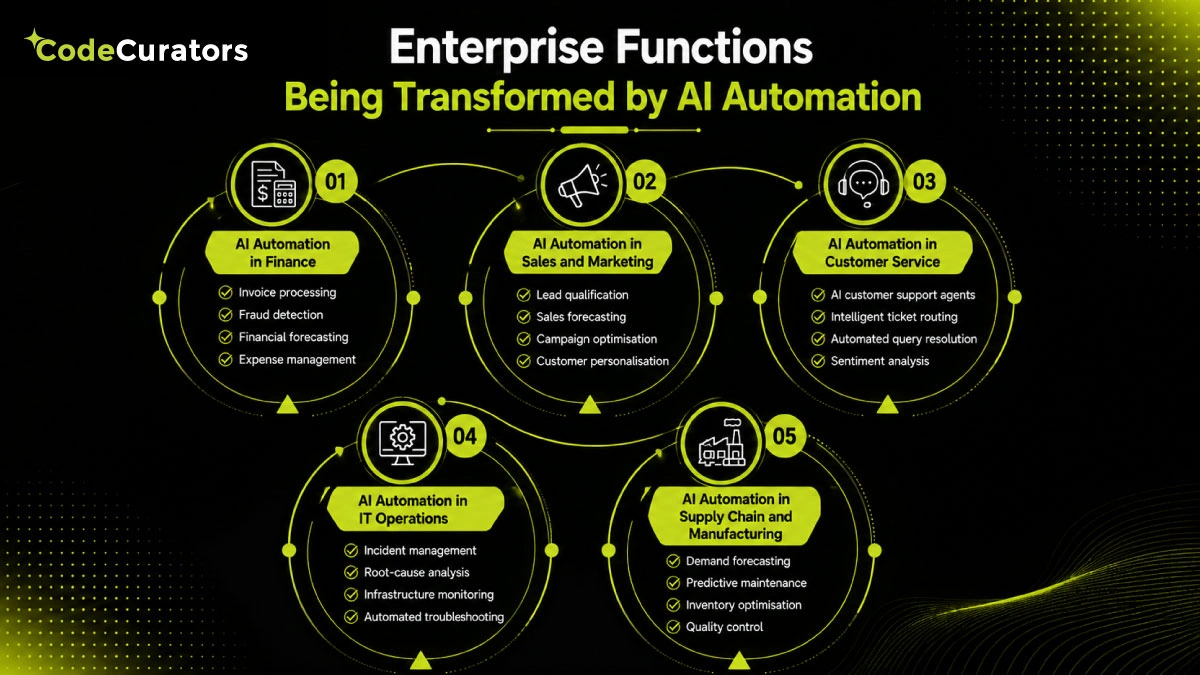
Enterprise Functions Being Transformed by AI Automation
➔ AI Automation in Finance
Finance teams are using AI automation to decrease manual labour and increase accuracy in all aspects of daily operations. AI is capable of processing invoices automatically, extracting data from financial records, and identifying unusual transactions for fraud detection. By analysing both past and present business data, predictive models can assist with financial forecasting. Additionally, AI-powered expense management can classify expenses and expedite approval processes. Finance professionals can allocate more time to analysis, planning, and strategic decision-making and less time to repetitive administration through AI automation.
➔ AI Automation in Sales and Marketing
AI automation is revolutionising marketing and sales by assisting teams in finding opportunities and customising customer interactions on a large scale. Sales teams can prioritise high-value prospects by using AI to qualify leads based on customer behaviour, engagement, and business criteria. By identifying patterns and possible changes in demand, predictive models can help with sales forecasting. AI can also be used by marketing teams for audience segmentation, campaign optimisation, and customised content. These features assist companies in increasing customer engagement, allocating resources efficiently, and developing more focused customer experiences.
➔ AI Automation in Customer Service
By managing routine interactions and assisting support teams in responding more quickly, AI automation can improve customer service. Without human assistance, AI customer service representatives are able to comprehend consumer enquiries, offer relevant data, and address typical problems. By evaluating requests and assigning them to the relevant team, an AI development solution can also facilitate intelligent ticket routing. While sentiment analysis detects customer emotions and possible escalations, AI can automate query resolution for repetitive cases. It helps organisations provide quicker, more reliable, and context-aware support.
➔ AI Automation in IT Operations
IT teams are using AI automation to more effectively manage incidents, monitor infrastructure, and fix technical problems. AI-powered systems are able to prioritise alerts according to their business impact, detect anomalous system behaviour, and identify possible incidents. Logs, events, and system dependencies can all be examined by root-cause analysis tools to find possible problem sources. By carrying out predetermined remediation actions, AI can also assist automated troubleshooting. AI frees up IT teams to concentrate on complicated problems and infrastructure upgrades by eliminating manual monitoring and repetitive response tasks.
➔ AI Automation in Supply Chain and Manufacturing
By facilitating quicker, data-driven decision-making, AI automation is improving supply chain and manufacturing operations. Demand forecasting models can predict future needs by analysing operational data, market conditions, and past sales. Equipment problems can be found with predictive maintenance before they interfere with production. By balancing supply, demand, and replenishment needs, AI can also maximise inventory levels. Computer vision and AI-based quality control can identify flaws and inconsistencies in products in manufacturing environments. These capabilities help businesses reduce waste, minimise downtime, increase production efficiency, and sustain more reliable supply chain operations.
Business Benefits of AI-Driven Enterprise Automation
AI-driven enterprise automation increases worker productivity, reduces operating costs, and helps businesses reduce repetitive manual tasks. Businesses can speed up procedures, automate repetitive tasks, and help with quicker, better-informed decision-making by using AI development services. Through tailored, responsive interactions, AI can improve customer experiences while allowing operations to grow effectively without correspondingly adding to workloads.
Additionally, automated systems can facilitate 24/7 process automation, which guarantees that vital workflows continue after regular business hours. AI improves business intelligence and offers useful insights for improved planning by continuously analysing business data. In the end, AI-driven automation improves operational agility, enabling businesses to react more quickly to shifting consumer needs, market dynamics, and corporate priorities.
Challenges Enterprises Face When Scaling AI Automation
➥ Data Quality and AI Readiness
AI performance may be hampered by inconsistent formats, fragmented enterprise data, and accuracy problems. Before scaling automation, organisations require robust data governance, suitable infrastructure, and reliable data pipelines.
➥ Integration With Legacy Systems
It can be difficult to integrate AI solutions with current ERP and CRM platforms due to incompatible architectures, restricted APIs, and compatibility problems. For seamless automation, legacy modernisation might be necessary.
➥ AI Security and Governance
Concerns about data privacy, access controls, legal compliance, and responsible AI use are raised by AI automation. To safeguard sensitive data and maintain accountability, businesses require well-defined governance frameworks.
➥ AI Cost and Performance Management
As workloads grow, AI adoption may result in higher infrastructure costs and model usage. To maintain efficiency and predictable operating costs, businesses must use AI observability, optimise resource consumption, and monitor performance.
➥ Employee Adoption and Skills Gaps
Employee comprehension, training, and efficient change management are necessary for successful AI automation. Promoting human-AI collaboration and encouraging AI proficiency can help employees confidently adjust to changing workflows.
Also Read: Best 11 AI Automation Companies in Australia to Consider in 2026
How Enterprises Can Prepare for AI-Driven Automation
⇒ Identify High-Value AI Automation Opportunities
Processes that are repetitive, data-intensive, high-volume, decision-heavy, or time-consuming should be given priority by businesses. By concentrating on these areas, real-world opportunities where AI automation can decrease manual labour, increase productivity, and provide measurable business value can be found.
⇒ Build an AI-Ready Data Foundation
Effective AI automation requires a solid data foundation. Businesses should create clear governance policies, integrate data across systems, improve data quality, and give authorised users and AI applications safe access to reliable data.
⇒ Start With Targeted AI Use Cases
Instead of attempting a large-scale transformation right away, organisations can start with targeted AI pilot projects. Reducing implementation risks and demonstrating value can be achieved through measuring business outcomes, improving workflows based on results, and scaling effective solutions.
⇒ Integrate AI With Existing Enterprise Systems
Instead of functioning as a stand-alone tool, AI should function within the enterprise technology environment. More beneficial automation and integrated workflows are made possible by integrating AI with CRM, ERP, business apps, APIs, data platforms, and knowledge systems.
⇒ Establish AI Governance from the Beginning
Businesses should set up governance before implementing AI automation. Organisations can preserve control, safeguard data, and encourage responsible AI adoption with the support of an AI development services provider. They manage security controls, AI monitoring, compliance procedures, audit trails, and access management.
What Is the Future of AI-Driven Enterprise Automation?
• AI agents will manage a wide range of complex tasks independently, making decisions, co-ordinating actions and completing workflows with less human intervention.
• Multiple specialised agents will collaborate, navigate tasks, share data, and co-ordinate processes across departments and business functions.
• Enterprise software widely includes AI capabilities from the foundation, making smart automation a core feature rather than an added layer.
• AI systems will frequently analyse workflow performance, identify inefficiencies, and manage processes automatically to improve speed, accuracy, and productivity.
• AI will become integrated with CRM and ERP platforms, allowing connected workflows, smart recommendations, and automated business processes.
• Companies will increasingly adopt specialised AI models trained for industry terminology, processes, regulations, and specific operational requirements.
• Employees & AI agents will work together, with AI managing routine execution while offering creativity and strategic direction.
• AI systems will analyse live business data, identify changing conditions, and make recommended decisions quickly across crucial operational processes.
• Enterprise will strengthen AI governance through frequent monitoring, security controls, transparency measures, and compliance frameworks.
Ready to Accelerate Enterprise Automation with AI Development?
Do you want to modernise your enterprise workflows with AI? Share your automation goals with an expert and discover the real-time opportunities for AI automation. Select an AI development company in Australia that helps to identify the ideal AI solutions for your organisation’s processes and operational requirements. Get a tailored roadmap for implementation, optimisation, and scaling AI automation. Follow these AI development trends to increase productivity, decision-making, and user experience.
DON'T FORGET TO SHARE

AI Development Tools That Streamline Data Science and Analytics
Explore AI development tools that streamline data science and analytics, automate workflows, and help businesses make smarter decisions…

Australia’s Top AI Development Companies in 2026: Complete List
Explore Australia’s top AI development companies in 2026, their services, strengths, and how to choose the right AI…
How Can We Help You?
Drop your details below and our engineering team will reach out within one business day.