AI Development 20 AUG 2026 · 17 MIN READ

Latest AI Development Trends Driving Automation Across Enterprises

Discover AI development trends driving enterprise automation with AI agents, generative AI, and intelligent workflows for efficiency and growth.

Poonam Kishan FOUNDER & DIRECTOR
SHARE
Latest AI Development Trends Driving Automation Across Enterprises

AI development is changing enterprise automation by allowing businesses to automate complicated processes, measure large data volumes, and support faster decision-making. Unlike traditional systems, advanced AI solutions can understand patterns, adapt to changing conditions, and help employees across various business functions. Enterprises working with an AI development company in Australia can develop AI-powered solutions tailored to their operational demand, data environments, and automation goals.

88% of firms frequently adopt AI in their business processes. The shift from rule-based automation to smart AI-driven systems is enabling firms to move beyond predefined workflows. AI development services dynamically determine data, make recommendations, manage multi-step tasks, and optimise processes depending on real-time business conditions.

As firms face rising operational challenges and pressure to improve efficiency, they are increasing investment in AI automation. Organisations are deploying AI to limit repetitive tasks, improve employee productivity, improve processes and user experiences, optimise costs, and scale operations. The rising focus is making AI-powered automation a necessary part of enterprise transformation strategies. Read the blog to know current trends in AI development and their benefits,

How AI Development Is Changing Enterprise Automation

◈ From Rule-Based Automation to Intelligent Automation

Traditional automation follows predetermined rules, whereas AI-driven automation can measure data, make decisions, and adapt to changing conditions. Smart systems support adaptive business workflows & data-driven process optimisation, enabling enterprises to manage complex scenarios, limit manual intervention, and improve operational efficiency across diverse business workflows.

◈ Why Enterprises Are Accelerating AI Adoption

Enterprises are moving towards AI adoption to improve operational efficiency, optimise costs, and increase productivity. The AI development company Australia allows faster decision-making, better customised user experience, and improved business scalability. By automating routine activities and supporting complicated operations, firms can respond faster to changing market demands while achieving sustainable operational improvements.
Ready to Explore AI Development Solutions for Your Enterprise Growth

Latest AI Development Trends Driving Enterprise Automation

1. Agentic AI for Autonomous Workflows

Enterprise automation is progressing beyond preset rules and scripts thanks to agentic AI. AI agents can work towards a predetermined goal, identify the necessary steps, and take action with minimal human intervention. Goal-based agents can be used by businesses to perform tasks like employee onboarding, IT service management, invoice processing, lead qualification, and customer support. These agents have the ability to assess data, make choices based on available information and business rules, and carry out multi-step procedures across interconnected applications.

The agents can recognise a customer problem, examine account data, open a service ticket, and inform the appropriate team. Since processes can adjust to changing conditions instead of adhering to strict sequences, this method allows for more flexible enterprise workflow automation. The custom AI development company can automate complicated operational tasks while maintaining human employees for exceptions, approvals, and high-impact decisions.

2. Multi-Agent AI Systems

By enabling several specialised AI agents to collaborate, multi-agent AI systems advance enterprise automation. Instead of depending on a single all-purpose agent, organisations can give each agent a variety of tasks according to their skills. An agent can manage communication or reporting, while another can manage financial validation and customer information analysis. These agents can be coordinated by an orchestration layer, which can also assign tasks, monitor progress, and decide when further actions are needed.

62% of firms are experimenting with AI agents. This method works especially well for complicated business processes involving several departments, systems, or decision points. For example, separate agents might be used in an automated procurement process to conduct supplier research, analyse prices, verify compliance, and create purchase orders. Businesses can create more organised and scalable automation workflows by allocating responsibilities. Additionally, by combining various AI models and tools that align with particular business needs, multi-agent systems enable organisations to create flexible automation.

3. Generative AI in Enterprise Applications

Generative AI is evolving into a useful feature within enterprise applications. To help employees with daily tasks, businesses are directly integrating AI capabilities into CRM, ERP, HR, finance, customer service, and collaboration platforms. Copilots with AI capabilities can create reports, draft emails, summarise customer interactions, explain business data, and guide employees in finding pertinent information without having to switch between several apps.

Proposals, product descriptions, meeting summaries, documentation, and management reports are just a few of the repetitive content creation tasks that generative AI can automate. AI can interact with relevant business data and workflows; these capabilities become more context-aware when integrated with enterprise systems. Users can comprehend operational or financial data in natural language with the help of ERP-integrated AI.

Organisations can decrease manual labour and increase worker productivity by hiring AI development companies in Australia. They make enterprise software more adaptable to specific business requirements through this integration.

4. Intelligent Workflow Automation

AI-based optimisation and decision-making are combined with conventional process automation in intelligent workflow automation. Intelligent workflows can assess incoming data and choose the best course of action, compared to following the same procedure for each request. Based on variables like urgency, customer value, staff availability, risk, or business rules, AI can dynamically route tasks. When certain requirements are fulfilled, it can also initiate automated approvals, notifications, data updates, and follow-up actions.

An insurance workflow might, for instance, evaluate a claim, identify low-risk cases for direct processing, and send complicated claims to experts for examination. Workflow performance can be continuously analysed by AI to find problems, unnecessary steps, and delays. Instead of depending solely on manual analysis, firms can integrate such metrics to improve processes.

Intelligent workflow automation is beneficial for supply chain, customer service, healthcare, finance, and human resources. Organisations can develop processes that are quicker, more flexible, and more in line with evolving operational requirements by integrating automation with contextual decision-making.

5. Enterprise RAG and Knowledge AI

Enterprise RAG, the AI development solution, is emerging as a key strategy for developing AI applications that leverage an organisation’s internal knowledge. RAG systems retrieve appropriate content from enterprise sources, rather than depending solely on information found within a language model. The context provided by the retrieved data enables the AI to produce more relevant answers. Applications like document analysis systems, employee helpdesks, internal knowledge assistants, and customer support tools can all benefit from this.

An employee might enquire about a company policy, for example, and get a response based on the organisation’s authorised documentation. By assisting employees in finding information quickly that would otherwise require manual searching, Enterprise RAG can also automate knowledge-intensive procedures.

Organisations can guarantee that users receive information according to their permissions by implementing suitable access controls. RAG and knowledge AI can assist companies in transforming fragmented data into easily accessible information as enterprise data continues to expand across various platforms.

6. Multimodal AI Development

Enterprise applications can comprehend and process various forms of information, such as text, images, audio, video, and documents, because of multimodal AI. These AI development trends 2026 open up possibilities for more organic interactions with business systems and extend automation beyond conventional text-based workflows. Another crucial use is document automation, especially for businesses that deal with a lot of contracts, forms, receipts, claims, and reports.

With less manual data entry, multimodal AI can extract relevant details from these documents and transfer them into business systems. Customers or employees can use voice-enabled apps to communicate with business systems in natural language. Visual AI can help with inspection and maintenance procedures in manufacturing and field services by analysing photos or videos. Businesses can develop enterprise applications that comprehend real-world data more thoroughly as models improve at integrating various information formats.

7. AI-Powered Software Development

Software teams’ planning, development, testing, and maintenance processes are being influenced by AI. Code generation, code completion, documentation, debugging, refactoring, and technical explanations are all areas where modern development tools can help. Beyond providing individual code recommendations, AI coding agents can assist with multi-step development tasks.

To increase development productivity, companies that work with an AI development services provider can also integrate AI into more comprehensive software engineering workflows. Another significant area where AI can assist with finding possible flaws, creating test cases, analysing failures, and improving test coverage is automated testing.

By helping with deployment workflows, monitoring, incident analysis, and infrastructure management, AI can also support DevOps automation. The requirement for skilled developers is not eliminated by these features. Rather, they can cut down on routine tasks so engineering teams may allocate more time to complex problem-solving, architecture, security, and business logic. As a result, AI-powered development is becoming a more crucial component of modern enterprise software delivery.

8. Predictive and Prescriptive AI

Businesses can use predictive and prescriptive AI to move from comprehending past data to projecting future results and making decisions. In order to predict events like customer demand, equipment failures, sales performance, cash flow, or supply chain disruptions, predictive AI examines patterns in the data that already exist. By suggesting actions that may improve business outcomes, prescriptive AI improves upon these forecasts. To cut down on stockouts or excess inventory, a retail company forecasts demand for particular products and suggests inventory adjustments.

While prescriptive systems suggest maintenance procedures and scheduling adjustments, predictive models can detect possible equipment failures in manufacturing. These capabilities can be used by financial institutions to support risk assessment and identify unusual behaviour. When incorporated into business processes, AI-generated forecasts and suggestions can automatically initiate the necessary actions for making decisions. This combination can help organisations better allocate resources and automate routine data-driven decisions while maintaining human oversight in complex or high-impact situations.

9. Edge AI for Real-Time Automation

Edge devices can process data locally and react instantly when necessary, as compared to sending all data points to a central cloud environment. In environments where quick decisions are crucial, this can lower latency and facilitate real-time automation. The following latest trends in AI development can be used by manufacturing facilities to analyse equipment conditions, identify quality problems, or find anomalies in operations right on the production floor.

Edge-based systems can facilitate real-time asset tracking, warehouse automation, and vehicle monitoring in logistics. Without relying solely on constant cloud connectivity, IoT applications can also use local AI processing to analyse sensor data and initiate actions. In limited bandwidth situations, this method may increase responsiveness while lowering the volume of data sent to central systems. When delays could compromise operational effectiveness, productivity, or safety, edge AI is especially helpful. Organisations can create distributed automation environments by combining edge intelligence with cloud-based AI as connected devices become more capable.

10. AI Governance and Observability

Governance and observability are becoming crucial for preserving control over automated applications as businesses implement more AI systems. AI monitoring enables businesses to monitor system performance, identify anomalous behaviour, assess results, and find problems after deployment. AI applications can only access the data and systems they are permitted to use thanks to security and access controls. Additionally, human oversight is crucial, especially when AI systems have an impact on operational, financial, customer, or employee decisions.

Clear procedures are necessary for organisations to review high-impact outputs and escalate situations that call for human judgement. By creating guidelines for data usage, model management, auditability, and risk assessment, AI governance can also help in compliance. Model performance, application activity, and changes in AI behaviour over time can all be seen with observability tools. Observability and governance work together to provide a framework for ethical enterprise AI adoption. Businesses can incorporate these controls into AI development and deployment processes from the outset rather than viewing governance as a last-stage requirement.

Also Read: AI Integration Cost in Australia for Small, Mid-Sized and Enterprise Businesses

How AI Agents Are Redefining Enterprise Automation

✦ AI Agents as Digital Co-Workers

AI agents are evolving into digital coworkers who support staff members with complex workflows while managing routine business tasks. They are capable of carrying out multi-step procedures, information analysis, action triggering, and task coordination among enterprise applications. AI agents can lessen manual labour and assist teams in concentrating on strategic and customer-facing tasks by collaborating with employees. Routine business processes can be carried out more quickly and consistently thanks to their ability to function across interconnected systems.

✦ Human-in-the-Loop AI Automation

When judgement, accountability, or risk management are crucial, human-in-the-loop AI automation keeps humans involved. While employees can review sensitive actions prior to execution through approval checkpoints, AI agents are capable of completing routine tasks. Additionally, human intervention can deal with uncommon circumstances, validate AI-generated outputs, and handle exceptions. By combining automation and human oversight, this strategy helps businesses manage operational risks, maintain quality, and make sure important decisions are accurate.
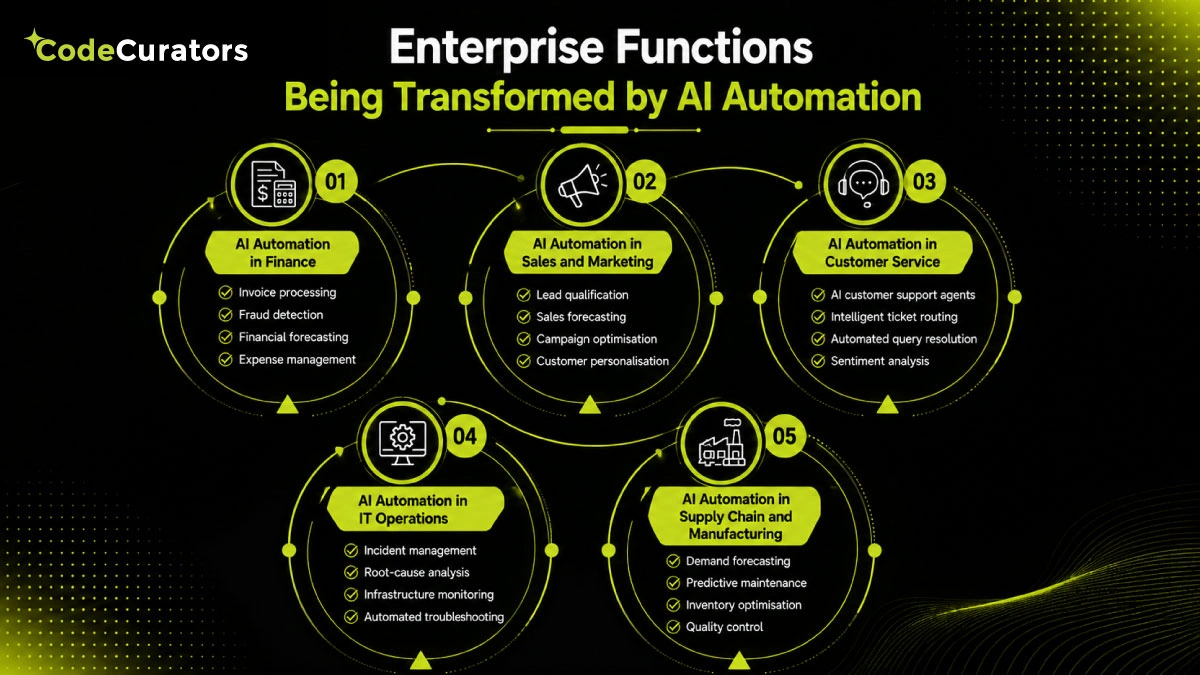
Enterprise Functions Being Transformed by AI Automation

Enterprise Functions Being Transformed by AI Automation

➔ AI Automation in Finance

Finance teams are using AI automation to decrease manual labour and increase accuracy in all aspects of daily operations. AI is capable of processing invoices automatically, extracting data from financial records, and identifying unusual transactions for fraud detection. By analysing both past and present business data, predictive models can assist with financial forecasting. Additionally, AI-powered expense management can classify expenses and expedite approval processes. Finance professionals can allocate more time to analysis, planning, and strategic decision-making and less time to repetitive administration through AI automation.

➔ AI Automation in Sales and Marketing

AI automation is revolutionising marketing and sales by assisting teams in finding opportunities and customising customer interactions on a large scale. Sales teams can prioritise high-value prospects by using AI to qualify leads based on customer behaviour, engagement, and business criteria. By identifying patterns and possible changes in demand, predictive models can help with sales forecasting. AI can also be used by marketing teams for audience segmentation, campaign optimisation, and customised content. These features assist companies in increasing customer engagement, allocating resources efficiently, and developing more focused customer experiences.

➔ AI Automation in Customer Service

By managing routine interactions and assisting support teams in responding more quickly, AI automation can improve customer service. Without human assistance, AI customer service representatives are able to comprehend consumer enquiries, offer relevant data, and address typical problems. By evaluating requests and assigning them to the relevant team, an AI development solution can also facilitate intelligent ticket routing. While sentiment analysis detects customer emotions and possible escalations, AI can automate query resolution for repetitive cases. It helps organisations provide quicker, more reliable, and context-aware support.

➔ AI Automation in IT Operations

IT teams are using AI automation to more effectively manage incidents, monitor infrastructure, and fix technical problems. AI-powered systems are able to prioritise alerts according to their business impact, detect anomalous system behaviour, and identify possible incidents. Logs, events, and system dependencies can all be examined by root-cause analysis tools to find possible problem sources. By carrying out predetermined remediation actions, AI can also assist automated troubleshooting. AI frees up IT teams to concentrate on complicated problems and infrastructure upgrades by eliminating manual monitoring and repetitive response tasks.

➔ AI Automation in Supply Chain and Manufacturing

By facilitating quicker, data-driven decision-making, AI automation is improving supply chain and manufacturing operations. Demand forecasting models can predict future needs by analysing operational data, market conditions, and past sales. Equipment problems can be found with predictive maintenance before they interfere with production. By balancing supply, demand, and replenishment needs, AI can also maximise inventory levels. Computer vision and AI-based quality control can identify flaws and inconsistencies in products in manufacturing environments. These capabilities help businesses reduce waste, minimise downtime, increase production efficiency, and sustain more reliable supply chain operations.

Business Benefits of AI-Driven Enterprise Automation

AI-driven enterprise automation increases worker productivity, reduces operating costs, and helps businesses reduce repetitive manual tasks. Businesses can speed up procedures, automate repetitive tasks, and help with quicker, better-informed decision-making by using AI development services. Through tailored, responsive interactions, AI can improve customer experiences while allowing operations to grow effectively without correspondingly adding to workloads.

Additionally, automated systems can facilitate 24/7 process automation, which guarantees that vital workflows continue after regular business hours. AI improves business intelligence and offers useful insights for improved planning by continuously analysing business data. In the end, AI-driven automation improves operational agility, enabling businesses to react more quickly to shifting consumer needs, market dynamics, and corporate priorities.

Challenges Enterprises Face When Scaling AI Automation

➥ Data Quality and AI Readiness

AI performance may be hampered by inconsistent formats, fragmented enterprise data, and accuracy problems. Before scaling automation, organisations require robust data governance, suitable infrastructure, and reliable data pipelines.

➥ Integration With Legacy Systems

It can be difficult to integrate AI solutions with current ERP and CRM platforms due to incompatible architectures, restricted APIs, and compatibility problems. For seamless automation, legacy modernisation might be necessary.

➥ AI Security and Governance

Concerns about data privacy, access controls, legal compliance, and responsible AI use are raised by AI automation. To safeguard sensitive data and maintain accountability, businesses require well-defined governance frameworks.

➥ AI Cost and Performance Management

As workloads grow, AI adoption may result in higher infrastructure costs and model usage. To maintain efficiency and predictable operating costs, businesses must use AI observability, optimise resource consumption, and monitor performance.

➥ Employee Adoption and Skills Gaps

Employee comprehension, training, and efficient change management are necessary for successful AI automation. Promoting human-AI collaboration and encouraging AI proficiency can help employees confidently adjust to changing workflows.

Also Read: Best 11 AI Automation Companies in Australia to Consider in 2026

How Enterprises Can Prepare for AI-Driven Automation

⇒ Identify High-Value AI Automation Opportunities

Processes that are repetitive, data-intensive, high-volume, decision-heavy, or time-consuming should be given priority by businesses. By concentrating on these areas, real-world opportunities where AI automation can decrease manual labour, increase productivity, and provide measurable business value can be found.

⇒ Build an AI-Ready Data Foundation

Effective AI automation requires a solid data foundation. Businesses should create clear governance policies, integrate data across systems, improve data quality, and give authorised users and AI applications safe access to reliable data.

⇒ Start With Targeted AI Use Cases

Instead of attempting a large-scale transformation right away, organisations can start with targeted AI pilot projects. Reducing implementation risks and demonstrating value can be achieved through measuring business outcomes, improving workflows based on results, and scaling effective solutions.

⇒ Integrate AI With Existing Enterprise Systems

Instead of functioning as a stand-alone tool, AI should function within the enterprise technology environment. More beneficial automation and integrated workflows are made possible by integrating AI with CRM, ERP, business apps, APIs, data platforms, and knowledge systems.

⇒ Establish AI Governance from the Beginning

Businesses should set up governance before implementing AI automation. Organisations can preserve control, safeguard data, and encourage responsible AI adoption with the support of an AI development services provider. They manage security controls, AI monitoring, compliance procedures, audit trails, and access management.

What Is the Future of AI-Driven Enterprise Automation?

• AI agents will manage a wide range of complex tasks independently, making decisions, co-ordinating actions and completing workflows with less human intervention.

• Multiple specialised agents will collaborate, navigate tasks, share data, and co-ordinate processes across departments and business functions.

• Enterprise software widely includes AI capabilities from the foundation, making smart automation a core feature rather than an added layer.

• AI systems will frequently analyse workflow performance, identify inefficiencies, and manage processes automatically to improve speed, accuracy, and productivity.

• AI will become integrated with CRM and ERP platforms, allowing connected workflows, smart recommendations, and automated business processes.

• Companies will increasingly adopt specialised AI models trained for industry terminology, processes, regulations, and specific operational requirements.

• Employees & AI agents will work together, with AI managing routine execution while offering creativity and strategic direction.

• AI systems will analyse live business data, identify changing conditions, and make recommended decisions quickly across crucial operational processes.

• Enterprise will strengthen AI governance through frequent monitoring, security controls, transparency measures, and compliance frameworks.
Let’s Discuss Your AI Development Goals and Business Needs

Ready to Accelerate Enterprise Automation with AI Development?

Do you want to modernise your enterprise workflows with AI? Share your automation goals with an expert and discover the real-time opportunities for AI automation. Select an AI development company in Australia that helps to identify the ideal AI solutions for your organisation’s processes and operational requirements. Get a tailored roadmap for implementation, optimisation, and scaling AI automation. Follow these AI development trends to increase productivity, decision-making, and user experience.

ABOUT THE AUTHOR

Poonam Kishan

Founder & Director

Poonam Kishan is the founder of Code Curators. With 16 years across software engineering, systems integration, and data engineering, spanning cloud, big data, and analytics platforms, she's built and delivered end-to-end data and AI solutions for enterprise clients across ANZ and beyond. She writes about what it actually takes to build systems that survive real users and stay accountable after launch.

● let's talk

How Can We Help You?

Drop your details below and our engineering team will reach out within one business day.
AI Development 18 JUN 2026 · 9 MIN READ

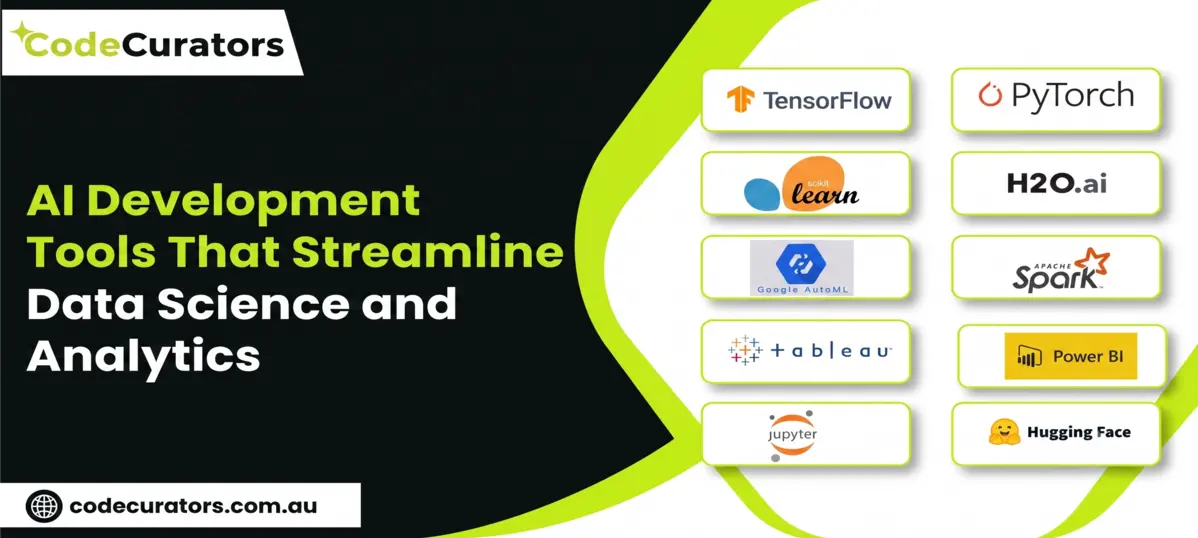
AI Development Tools That Streamline Data Science and Analytics

Explore AI development tools that streamline data science and analytics, automate workflows, and help businesses make smarter decisions faster.

Poonam Kishan FOUNDER & DIRECTOR
SHARE
AI Development Tools That Streamline Data Science and Analytics

The AI revolution is changing the way firms measure and process data efficiently. Data analytics is the crucial element of business operations, but it can be challenging. To address this challenge, AI development services have emerged, supporting firms in streamlining and automating the data analysis process without hampering accuracy. AI & data analytics are rising frequently in the data-driven landscape.

As per the market research, by 2032, the AI market is expected to reach $2.740.46 billion, whereas the AI market is expected to reach $924.39 billion. Data analytics & AI are advanced technologies; when integrated, they unlock various levels of efficiency. Organizations can benefit from faster & accurate analysis by blending an custom ai development company with data analytics. The following blog represents the top 10 AI tools that promise quick, real-time data processing. This blog is going to be helpful for business analysts, data scientists, and marketing experts to make their tasks easier.

Understanding AI Development Tools

➔ What Are AI Development Tools?

AI development tools are software systems, frameworks & platforms that are designed for automating, accelerating, and supporting SDLC. These top AI development tools support developers to write code, monitor bugs, automate QA, build UI, and release the app much faster than traditional methods.

To perform your task accurately, it’s necessary to choose the ideal tool. Selection of the wrong AI development solution can break down the entire software. So, it’s time to perform a few researches before you release products. There are various AI development tools, but the most popular are cloud-based platforms, open-source software, and low-cost development tools.

Scale Analytics Faster with AI Development Tools

➔ Why These Tools Matter for Data Science

Data science tools are responsible for transforming raw and unstructured data into actionable metrics. These tools streamline each step of the workflow from cleaning data & running statistical models to developing predictive ML models & interactive visualizations for organization leaders. Mastering the ideal tools with an AI development company in Australia matters since they directly measure how effectively & accurately a data analyst expert can operate.

Top AI Development Tools for Data Science and Analytics

1. TensorFlow

TensorFlow

TensorFlow is Google’s open-source ML platform used by AI development companies in Australia. It can handle deep learning, neural networks, and large-scale data processing. Its flexible structure enables developers and data scientists to build advanced AI applications while leveraging powerful tools, libraries, and community support.

◈ Features

• Deep Learning Support
• Scalable Architecture
• TensorFlow Lite model deployment tools
• GPU Acceleration

◈ Use Case

It is globally used for image recognition, predictive analytics, recommendation systems, NLP, and enterprise AI applications.

2. PyTorch

PyTorch

PyTorch is used for AI research and production. It is well-known by the AI development companies in Australia for its flexibility and dynamic computation graphs, which allow for quick experimentation and model creation. PyTorch is preferred by developers for constructing complex machine learning models that are both easy to use and scalable.

◈ Features

• Dynamic computation graphs
• GPU support
• Distributed training
• Extensive libraries
• Research-friendly setting

◈ Use Case

The custom AI development company uses this for computer vision, NLP, Gen AI, academic research, and ML solutions worldwide.

3. Scikit-learn

Scikit-learn

This popular tool focuses on analyzing data and predictive modeling. It offers easy and effective methods for data preprocessing. Its user-friendly interface and rich documentation make it one of the most popular tools used by AI development services providers.

◈ Features

• Classification algorithms
• Regression models
• Clustering Tools
• Data Preprocessing and Model Evaluation

◈ Use Case

Frequently used for consumer segmentation, forecasting, predictive analytics, business intelligence, and data-driven decision-making applications.

4. H2O.ai

H2O.ai

H2O.ai is an AI and machine learning platform that enables businesses to construct intelligent models faster. It combines automation, scalability, and explainable AI capabilities to speed up development. H2O.ai helps businesses simplify machine learning operations and generate meaningful insights from complicated datasets in a fast and reliable manner.

◈ Features

• AutoML capabilities
• Explainable AI
• Distributed computing
• Model monitoring
• Enterprise scalability

◈ Use Case

This AI development tool helps healthcare, banking, insurance, customer analytics, and risk assessment applications that require advanced predictive modeling.

5. Google AutoML

Google AutoML

Google AutoML enables organizations to create machine learning models without requiring considerable coding experience. It automates numerous parts of AI model development, training, and deployment. Organizations frequently collaborate with a custom AI development company to properly use AutoML and drive digital transformation through intelligent automation efforts.

◈ Features

• Automated training with cloud integration.
• Pre-trained models.
• User-friendly UI with scalable infrastructure.

◈ Use Case

These are the best AI tools for development, image classification, text analysis, forecasting, consumer behavior prediction, and AI-powered business applications.

6. Apache Spark

Apache Spark

Apache Spark is a strong open-source data processing engine targeted at large-scale analytics and ML. Its distributed computing architecture enables rapid analysis of large datasets. Spark helps organizations manage massive data workloads efficiently while also supporting real-time analytics and powerful ML applications.

◈ Features

• Distributed processing.
• Real-time analytics with ML support.
• In-memory Computing.
• High scalability.

◈ Use Case

These best AI app development tools are used for fraud detection, recommendation engines, real-time processing, and enterprise big data analytics projects.

7. Tableau

Tableau

Tableau is a prominent data visualization software that enables businesses to turn difficult data into valuable insights. Its simple interface enables users to generate interactive dashboards and reports without requiring substantial technical knowledge. Organizations use Tableau, an AI development tool, to make better decisions and effectively communicate data results across teams.

◈ Features

• Interactive Dashboards
• Drag-and-drop interface
• Data blending
• Real-time reporting
• Cloud connectivity

◈ Use Case

It is suitable for sales analytics, executive reporting, performance monitoring, and business intelligence efforts across sectors.

8. Power BI

Power BI

Microsoft Power BI is a commercial analytics application that visualizes and shares data insights. It integrates many data sources and transforms them into impressive insights & dashboards. Businesses leverage Power BI to track performance, identify trends, and inform strategic choices by providing easy and data-driven reports.

◈ Features

• Interactive reporting
• AI-driven insights
• Microsoft Integration
• Dashboard creation
• Cloud accessibility

◈ Use Case

An ideal tool must be used for financial reporting, KPI tracking, operational analytics, and enterprise-wide BI projects.

9. Jupyter Notebook / Lab

Jupyter Notebook / Lab

Jupyter Notebook and JupyterLab are interactive platforms for coding, analysis, and machine learning development. They let users mix code, visuals, and documentation in a single workspace. Data scientists frequently utilize Jupyter for testing, collaboration, and model creation in a variety of AI and analytics applications.

◈ Features

• Interactive coding
• Visualization assistance
• Multi-lingual compatibility
• Collaborative workflows
• Notebook sharing

◈ Use Case

It is ideal for data exploration, ML experiments, research initiatives, and educational analytics applications worldwide.

10. Hugging Face Transformers

Hugging Face Transformers

Hugging Face Transformers is a commonly used AI library that provides access to advanced pre-designed transformer models. It facilitates the development of Gen AI apps. Developers use its broad model ecosystem to quickly create intelligent solutions while minimizing training time and complexity.

◈ Features

• Pre-trained models
• NLP Tools
• Model fine-tuning
• Extensive Model Hub
• Framework Compatibility

◈ Use Case

This best AI tool for development is used for chatbots, translation, sentiment analysis, content production, and advanced Gen AI applications across a variety of industries.

Integrating AI Tools into Your Data Science Workflow

Choosing the Right Tool for Your Needs

Assess dataset size and complexity

Before choosing an AI tool, measure the size, quality, and challenges of datasets. Large datasets often demand scalable platforms with fragmented computing capabilities, whereas smaller projects may benefit from lightweight solutions. Understanding data demands supports ensuring effective processing, accurate model training & optimal performance.

Consider team expertise and resources

The effectiveness of AI solutions is based on the skills & resources available within your firm. Firms investing in AI development services must select tools that align with the team’s technical expertise. User-friendly platforms can drive adoption, limit training demands, and drive project efficiency.

Evaluate cost and scalability

Cost & scalability are the crucial factors when integrating AI in your workflow. Consider licensing fee, infrastructure demands, and long-term operational excellence. Choose tools that scale with rising data volumes & organization demands. It ensures consistent performance & better ROI.

Best Practices for Tool Integration

Combine multiple tools for an end-to-end workflow

The team must use various AI & analytics tools altogether, and develop a seamless data science workflow. Firms can leverage specialized platforms for data preparation, model development, visualization, and release. Integrating advanced tools drives efficiency, limits manual efforts, and ensures smooth collaboration across the team throughout the project lifecycle.

Standardize coding practices and documentation

Establish the consistent coding standards & manage detailed documentation, supporting teams to work effectively. Standardized practices drive code quality, streamline collaboration, and make the project easier to manage. Clear reports also support sharing expertise, faster onboarding, and effective troubleshooting as workflows become complex.

Regularly update libraries and frameworks

Keep the AI libraries, frameworks, and development tools upgraded. It ensures accessibility to advanced features, performance enhancements, and security. Frequent upgrades support managing compatibility with advanced technologies, limit technical debt, and allow the team to develop reliable, scalable, and effective data science solutions.

Challenges and Considerations

Data privacy and security concerns

AI tools often operate on a vast volume of crucial business & user data, making privacy and security a crucial concern. Firms must integrate strong access controls, encryption, and compliance practices to safeguard data. It helps to limit risks and ensure adherence to industry compliance and data safety standards.

Tool compatibility and integration issues

Integrating various AI tools into current systems can develop compatibility challenges. Differences in data formats, APIs, and infrastructure demands may impact workflow efficiency. Careful planning, testing, and choosing interoperable solutions helps to limit breakdowns and smooth integration across business processes.

Over-reliance on automation vs human oversight

Automation enhances efficiency and minimizes manual efforts, but relying on AI can lead to mistakes or biased outcomes. Human oversight remains crucial for validating outcomes, measuring reports, and making valuable choices. The balanced approach verifies accuracy and the potential of AI tools.

Talk to Our AI Experts for Smarter Data Analytics

Ready to Supercharge Your Business with AI Development Tools?

AI data analytics solutions can process & measure a large volume of data instantly & accurately. AI is changing the way businesses manage and interpret data. With AI-driven tools, firms can make data-driven & faster decisions. Organizations can obtain immense benefits from AI solutions & data processing.

It helps with cost reduction, customized user experience, and automation. The following AI development tools list we have mentioned have the potential to give superior data-driven outcomes. Explore the full potential of these AI tools by collaborating with an AI development company in Australia.

ABOUT THE AUTHOR

Poonam Kishan

Founder & Director

Poonam Kishan is the founder of Code Curators. With 16 years across software engineering, systems integration, and data engineering, spanning cloud, big data, and analytics platforms, she's built and delivered end-to-end data and AI solutions for enterprise clients across ANZ and beyond. She writes about what it actually takes to build systems that survive real users and stay accountable after launch.

● let's talk

How Can We Help You?

Drop your details below and our engineering team will reach out within one business day.
AI Development 15 JUN 2026 · 10 MIN READ

Australia’s Top AI Development Companies in 2026: Complete List

Explore Australia’s top AI development companies in 2026, their services, strengths, and how to choose the right AI partner for your business.

Poonam Kishan FOUNDER & DIRECTOR
SHARE
Australia’s Top AI Development Companies in 2026: Complete List

Australia is considered the ideal destination for virtual transformation and AI innovation. The technical environment of Australia is thriving with government-driven innovation programs and AI-driven startups. The recent market reports show that the Australian AI market has reached over USD 6 billion in 2025 and is expected to rise rapidly over the upcoming years.

Many firms make mistakes when there is no development guidance and then end up with delays. Every industry is now utilising AI development services to enhance customer service, automate routine tasks & uplift user service. The companies are using automated routine tasks, drive data, and design advanced virtual products.

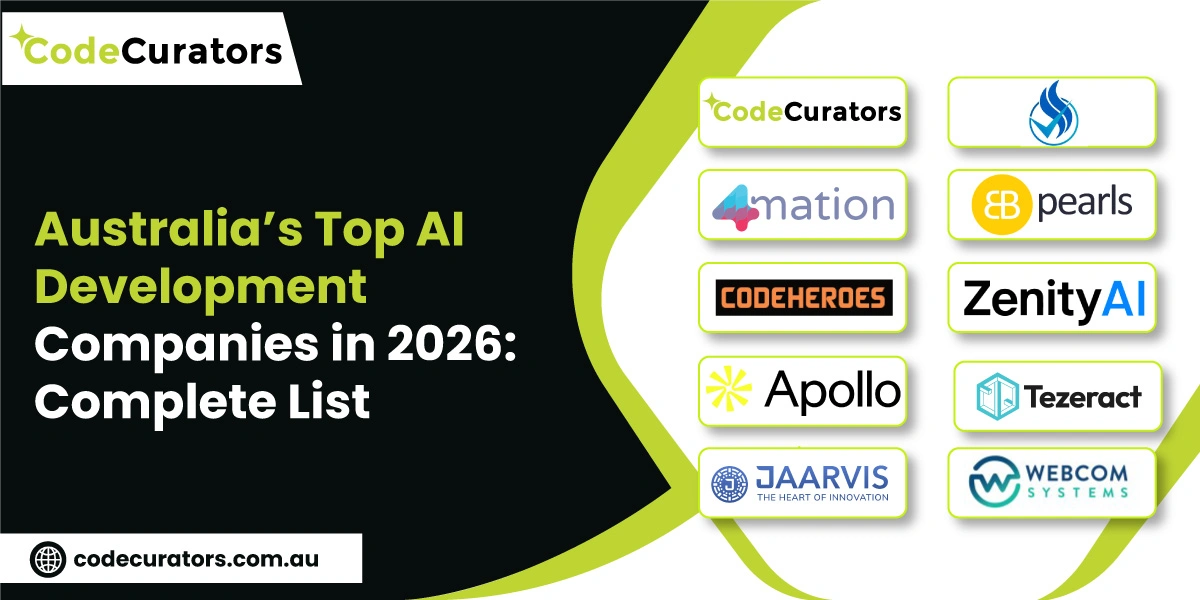
As the adoption of AI is rising, seeking a proven, trusted AI development partner is necessary. Since Australia has a skilled tech workforce & advanced infrastructure, here you can find the specialities. This blog post presents the top 10 AI development companies in Australia you can prefer to release your next development project.

Australia’s AI Development Market Overview

Australia’s AI Landscape in 2026

The AI landscape of Australia in 2026 is witnessing strong growth, driven by government initiatives, enterprise adoption, and growth in ML and Gen AI. The key sectors, including finance, e-commerce, medical care, mining, logistics, and manufacturing, are integrating AI into their business to automate their workflows. AI development services are used for enhancing efficiency, driving user experience, and innovation. Frequent investment in AI professionals and infrastructures is driving market growth.

Future Prospects in AI Development

The future of AI development solutions in Australia seems promising, with rising demands for Gen AI, smart automation, predictive analytics, and computer vision. Over the upcoming years, firms are expected to invest in AI-based transformation initiatives. Strong regulatory frameworks, rising technologies and industry-driven apps will develop significant opportunities for productivity, innovation and growth.

Looking for Trusted AI Development Services?

Challenges in Choosing the Right AI Development Company in Australia

Understanding Technical Expertise

Choosing the best AI development company in Australia can be difficult because many vendors offer comparable services. Businesses should assess their skills in advanced technologies. Reviewing technical capabilities, project complexity, and innovation experience can help differentiate reputable AI specialists from software development organisations.

Industry Relevance

Industry-specific experience is required for successful AI implementation. Companies specialising in healthcare, banking, retail, or manufacturing have a greater understanding of regulatory regulations, consumer expectations, and operational issues. Reviewing case studies, client success stories, and previous projects can assist in deciding whether the AI development services provider can deliver industry-specific AI solutions.

Budget and ROI Considerations

Cost is a crucial consideration, but the least expensive solution may not produce the best outcomes. Businesses should compare development expenses to predicted ROI, implementation timetables, and long-term value. Understanding additional charges like integrations, maintenance, updates, and training can help you minimise budget overruns and unforeseen project costs.

Post-Launch Support and Scalability

AI initiatives necessitate ongoing monitoring, optimisation, and maintenance following deployment. Businesses should consider whether the vendor provides ongoing support, performance enhancements, and technical assistance. It is also critical to ensure that AI solutions can expand effectively as data quantities, users, and business requirements grow over time.

Trust and Reputation

Trust is essential when choosing an AI development company in Australia. Organisations should look at client testimonials, references, online reviews, and project outcomes. Awards, certifications, industry recognition, and a track record of successful AI deployments increase trust in the company’s expertise and dependability.

Top AI Development Companies in Australia in 2026

1. Code Curators

Code Curators Australia

Code Curators Australia provides AI development, machine learning, automation, and custom software solutions to enterprises seeking digital transformation. This AI development company in Australia has a primary focus on developing intelligent apps that increase operational efficiency, automate procedures, and improve customer experiences. Their expertise includes AI integration, predictive analytics, and cloud solutions.

Sr. No. Key Points Services Provided
1 Founded Year: 2024 AI Development
2 Employees: 2 – 10 AI Integration
3 Location: Australia AI Chatbot Development
4 LinkedIn: View Profile LLM Development
5 Website: Code Curators AI Consulting

2. SupportSoft Technologies

SupportSoft Technologies

SupportSoft Technologies offers AI-driven business solutions. The AI development company assists organisations in integrating AI to automate operations & speed up user interaction. Their offerings include AI consultancy, application development, data analytics, cloud integration, and enterprise technology solutions tailored to specific corporate needs.

Sr. No. Key Points Services Provided
1 Founded Year: 2010 AI Development
2 Employees: 11 – 50 App Development
3 Location: Australia Software Development
4 LinkedIn: View Profile DIgital Marketing

3. 4mation

4mation

4mation is a custom AI development company that focuses on AI development, web apps, digital products, and software engineering. The company collaborates with organisations to develop intelligent solutions that streamline operations and boost business results. Their specialities include machine learning, cloud technologies, custom software development, and user-centred digital transformation efforts.

Sr. No. Key Points Services Provided
1 Founded Year: 2001 AI Development
2 Employees: 51 – 200 Website Design
3 Location: Australia Website Development
4 LinkedIn: View Profile SEO

4. EB Pearls

EB Pearls

EB Pearls is a major software and AI development company in Australia that creates unique digital products and intelligent solutions. Their team creates AI-powered solutions, mobile apps, and enterprise tools to support firms in driving customer satisfaction. They work with startups, companies, and emerging organisations across a variety of industries.

Sr. No. Key Points Services Provided
1 Founded Year: 2004 Big Data Analytics
2 Employees: 201 – 500 Data Science
3 Location: Australia AI Development
4 LinkedIn: View Profile AI Agents

5. Code Heroes

Code Heroes

Code Heroes offers AI development, custom software engineering, and digital innovation services to organisations in Australia. The company specialises in developing scalable technological solutions that combine automation, machine learning, and modern analytics. Their knowledge enables organisations to optimise workflows, increase productivity, and boost digital transformation using current software solutions.

Sr. No. Key Points Services Provided
1 Founded Year: 2008 AI Development
2 Employees: 11 – 50 Mobile Testing
3 Location: Australia Software Development
4 LinkedIn: View Profile Backend Development

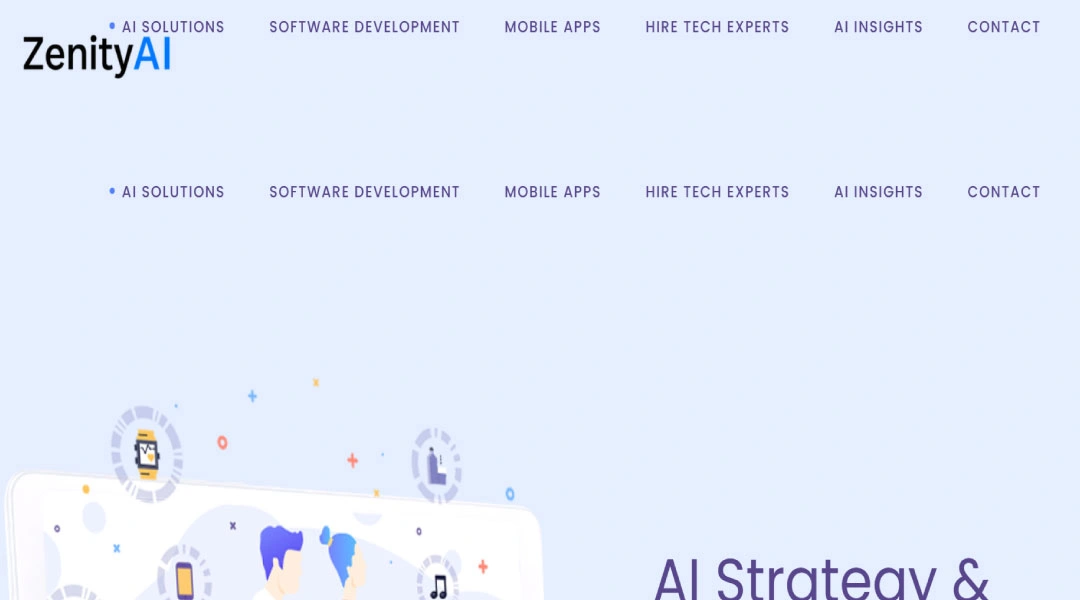
6. ZenityAI

ZenityAI

ZenityAI specialises in artificial intelligence solutions that enable businesses to automate operations and derive meaningful insights from data. The company creates AI-powered platforms, predictive models, and intelligent automation technologies to boost productivity and decision-making. Their services help organisations develop scalable AI technology.

Sr. No. Key Points Services Provided
1 Founded Year: 2015 AI Development
2 Employees: 51 – 200 Mobile Applications
3 Location: Australia Digital Business Analyst
4 LinkedIn: View Profile Software Consulting

7. Apello Software

Apello Software

Appello Software provides AI development, mobile app development, and custom software solutions to startups and corporations. The company incorporates artificial intelligence into its digital solutions to boost functionality, automate processes, and improve user experiences. Their multidisciplinary team is focused on innovation, scalability, and creating demonstrable business value via technology.

Sr. No. Key Points Services Provided
1 Founded Year: 2017 AI Development
2 Employees: 51 – 200 Software Development
3 Location: Australia User Experience Design
4 LinkedIn: View Profile Web Development

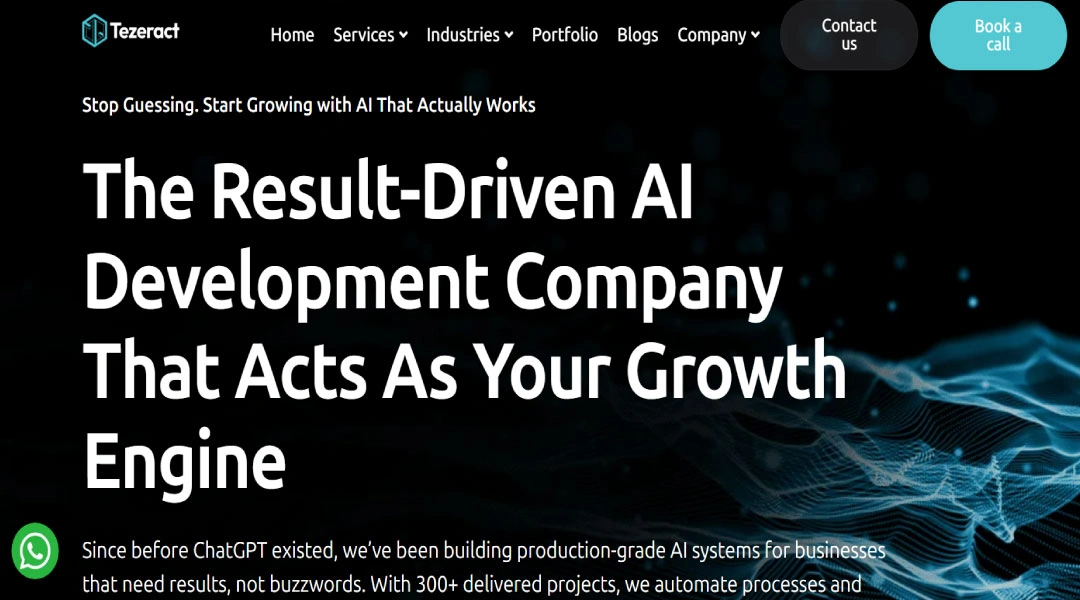
8. Tezeract

Tezeract

Tezeract is a startup that develops AI and machine learning technology to help businesses grow and become more efficient. They offer AI consultancy, predictive analytics, NLP and automation. The company collaborates with organisations to turn data into meaningful business insights and possibilities.

Sr. No. Key Points Services Provided
1 Founded Year: 2021 AI Development
2 Employees: 11 – 50 Data Science
3 Location: Australia Machine Learning
4 LinkedIn: View Profile Full-Stack Development

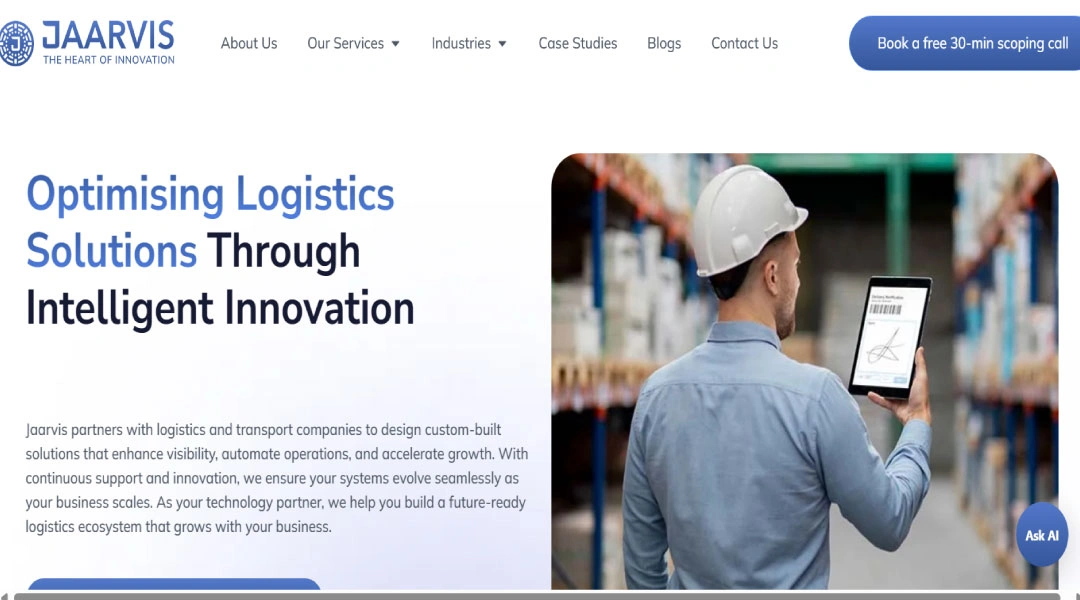
9. Jaarvis Technologies

Jaarvis Technologies

Jaarvis Technologies offers AI software solutions, digital transformation services, and business technology consultancy. The company’s focus is on developing intelligent technologies that increase operational performance, automate repetitive operations, and enable data-driven decision-making.

Sr. No. Key Points Services Provided
1 Founded Year: 2013 AI Development
2 Employees: 51 – 200 Software Development
3 Location: Australia Generative AI
4 LinkedIn: View Profile Website Development

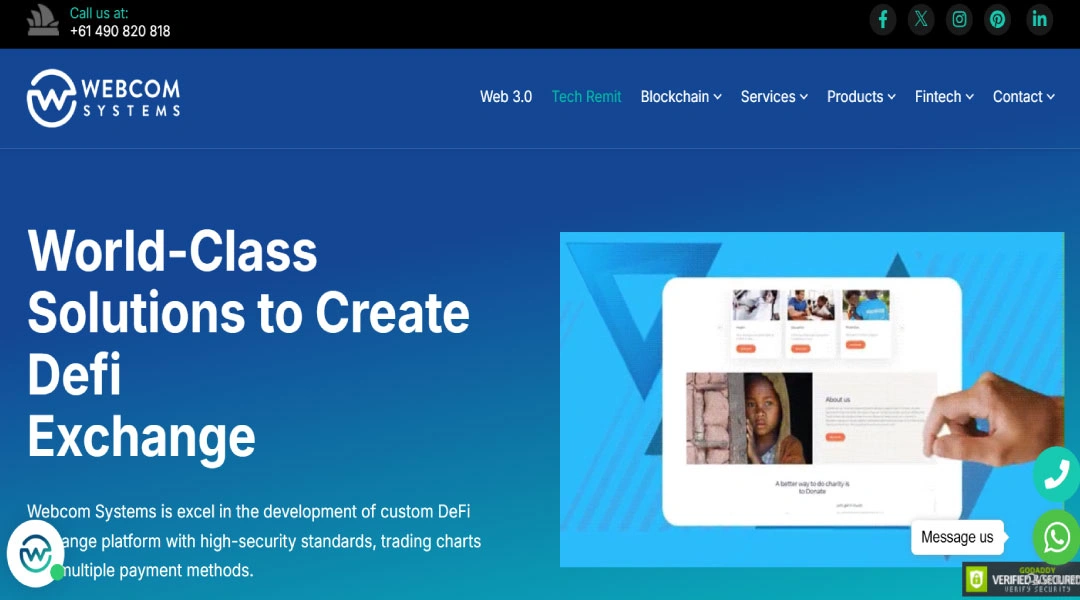
10. Webcom Systems

Webcom Systems

Webcom Systems provides AI development, software engineering, and digital transformation services to businesses looking for new technological solutions. The custom AI development company creates intelligent applications that boost productivity, streamline operations, and increase client engagement. They offer AI integration, automation, analytics, cloud technologies, and custom software development.

Sr. No. Key Points Services Provided
1 Founded Year: 1998 AI Development
2 Employees: 51 – 200 Website Development
3 Location: Australia Software Development
4 LinkedIn: View Profile Digital Marketing

How We Ranked AI Development Companies

Selection Criteria

Years of experience in AI

Companies with significant AI expertise often exhibit superior technical capabilities, proven procedures, and effective project delivery across multiple projects.

Project portfolio & client success

A solid portfolio and measurable client outcomes demonstrate the top AI development company’s capability to provide successful, business-focused AI solutions.

Innovation & patents

Innovation, exclusive technology, and patents demonstrate a company’s dedication to expanding AI capabilities and gaining a competitive advantage.

Market reputation

Industry recognition, client testimonials, accolades, and favourable feedback all contribute to the credibility and service quality of an AI development services company.

Team expertise

Skilled AI engineers, data scientists, architects, and consultants guarantee that projects are completed successfully and solutions operate well over time.

Data Sources

Industry reports used

Industry papers, market studies, technological analysis, and publications on AI adoption trends are all sources of information for research.

Customer reviews and case studies

Verified customer feedback, testimonials, and case studies are useful indicators of project success and client satisfaction.

Expert insights

To assure accuracy, the analysis includes the opinions of AI specialists, technological leaders, consultants, and industry experts.

Key AI Development Technology Trends

Generative AI Development

Generative AI is reshaping content creation, customer service, & software development. Organisations employ AI for chatbots, code generation, personalised marketing, and information management. Leading technology suppliers continue to advance massive language models, assisting organisations in achieving new efficiencies, innovation opportunities, and competitive advantages across industries.

AI Development & Automation in Business

AI-powered automation increases operational efficiency by decreasing manual activities, speeding up decision-making, and improving customer experiences. Businesses employ artificial intelligence (AI) for predictive analytics, workflow automation, intelligent customer service, and process optimisation. Successful implementations show quantifiable increases in productivity, cost reductions, scalability, and overall corporate performance.

Ethical AI Development and Regulation

As AI adoption increases, organisations must address data safety and transparency. Australia is strengthening AI governance frameworks to encourage trust and compliance. Choosing a custom AI development company with strong ethical procedures ensures that AI solutions are secure, transparent, and accountable.

How to Choose the Right AI Development Partner

Assess Project Requirements

Before choosing an AI development company in Australia, describe your business goals, project scope, and intended outcomes. Determine if you require ML, Gen AI, and NLP solutions. Budget expectations and success indicators help you discover partners who meet your technical and financial needs.

Evaluate Technical Expertise

Examine the company’s experience with applicable AI technologies, development frameworks, and deployment settings. Examine case studies, industry experience, and project portfolios to determine their capacity to address problems like yours. A solid technological basis and demonstrated implementation experience are important predictors of long-term project success.

Post-Launch Support

Successful AI programs necessitate ongoing maintenance, monitoring, and performance optimisation following deployment. Evaluate the provider’s support skills, service level agreements, process updates, and response. Reliable post-launch support ensures that your AI technology stays secure, scalable, efficient, and adaptable to changing business needs over time.

Ready to Talk with AI Development Experts?

Ready to Take Your AI Development to the Next Level?

The selection of the best AI development company in Australia can redesign how a firm grows and competes in the market. The companies we have listed above are leveraged with unique strengths. From custom solution development to integrating enterprise AI strategies, these companies are great for each task.

If you are seeking to develop customised AI solutions, choose an AI development services provider that matches your business vision.

ABOUT THE AUTHOR

Poonam Kishan

Founder & Director

Poonam Kishan is the founder of Code Curators. With 16 years across software engineering, systems integration, and data engineering, spanning cloud, big data, and analytics platforms, she's built and delivered end-to-end data and AI solutions for enterprise clients across ANZ and beyond. She writes about what it actually takes to build systems that survive real users and stay accountable after launch.

● let's talk

How Can We Help You?

Drop your details below and our engineering team will reach out within one business day.