

The AI revolution is changing the way firms measure and process data efficiently. Data analytics is the crucial element of business operations, but it can be challenging. To address this challenge, AI development services have emerged, supporting firms in streamlining and automating the data analysis process without hampering accuracy. AI & data analytics are rising frequently in the data-driven landscape.
As per the market research, by 2032, the AI market is expected to reach $2.740.46 billion, whereas the AI market is expected to reach $924.39 billion. Data analytics & AI are advanced technologies; when integrated, they unlock various levels of efficiency. Organizations can benefit from faster & accurate analysis by blending an custom ai development company with data analytics. The following blog represents the top 10 AI tools that promise quick, real-time data processing. This blog is going to be helpful for business analysts, data scientists, and marketing experts to make their tasks easier.
Understanding AI Development Tools
➔ What Are AI Development Tools?
AI development tools are software systems, frameworks & platforms that are designed for automating, accelerating, and supporting SDLC. These top AI development tools support developers to write code, monitor bugs, automate QA, build UI, and release the app much faster than traditional methods.
To perform your task accurately, it’s necessary to choose the ideal tool. Selection of the wrong AI development solution can break down the entire software. So, it’s time to perform a few researches before you release products. There are various AI development tools, but the most popular are cloud-based platforms, open-source software, and low-cost development tools.
➔ Why These Tools Matter for Data Science
Data science tools are responsible for transforming raw and unstructured data into actionable metrics. These tools streamline each step of the workflow from cleaning data & running statistical models to developing predictive ML models & interactive visualizations for organization leaders. Mastering the ideal tools with an AI development company in Australia matters since they directly measure how effectively & accurately a data analyst expert can operate.
Top AI Development Tools for Data Science and Analytics
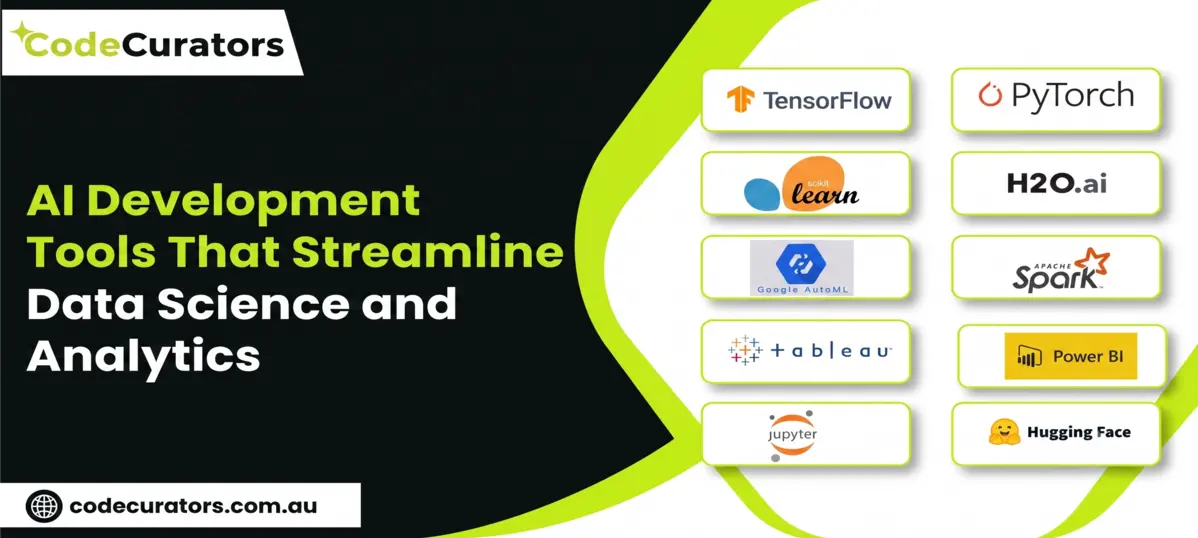
1. TensorFlow

TensorFlow is Google’s open-source ML platform used by AI development companies in Australia. It can handle deep learning, neural networks, and large-scale data processing. Its flexible structure enables developers and data scientists to build advanced AI applications while leveraging powerful tools, libraries, and community support.
◈ Features
• Deep Learning Support
• Scalable Architecture
• TensorFlow Lite model deployment tools
• GPU Acceleration
◈ Use Case
It is globally used for image recognition, predictive analytics, recommendation systems, NLP, and enterprise AI applications.
2. PyTorch

PyTorch is used for AI research and production. It is well-known by the AI development companies in Australia for its flexibility and dynamic computation graphs, which allow for quick experimentation and model creation. PyTorch is preferred by developers for constructing complex machine learning models that are both easy to use and scalable.
◈ Features
• Dynamic computation graphs
• GPU support
• Distributed training
• Extensive libraries
• Research-friendly setting
◈ Use Case
The custom AI development company uses this for computer vision, NLP, Gen AI, academic research, and ML solutions worldwide.
3. Scikit-learn

This popular tool focuses on analyzing data and predictive modeling. It offers easy and effective methods for data preprocessing. Its user-friendly interface and rich documentation make it one of the most popular tools used by AI development services providers.
◈ Features
• Classification algorithms
• Regression models
• Clustering Tools
• Data Preprocessing and Model Evaluation
◈ Use Case
Frequently used for consumer segmentation, forecasting, predictive analytics, business intelligence, and data-driven decision-making applications.
4. H2O.ai

H2O.ai is an AI and machine learning platform that enables businesses to construct intelligent models faster. It combines automation, scalability, and explainable AI capabilities to speed up development. H2O.ai helps businesses simplify machine learning operations and generate meaningful insights from complicated datasets in a fast and reliable manner.
◈ Features
• AutoML capabilities
• Explainable AI
• Distributed computing
• Model monitoring
• Enterprise scalability
◈ Use Case
This AI development tool helps healthcare, banking, insurance, customer analytics, and risk assessment applications that require advanced predictive modeling.
5. Google AutoML

Google AutoML enables organizations to create machine learning models without requiring considerable coding experience. It automates numerous parts of AI model development, training, and deployment. Organizations frequently collaborate with a custom AI development company to properly use AutoML and drive digital transformation through intelligent automation efforts.
◈ Features
• Automated training with cloud integration.
• Pre-trained models.
• User-friendly UI with scalable infrastructure.
◈ Use Case
These are the best AI tools for development, image classification, text analysis, forecasting, consumer behavior prediction, and AI-powered business applications.
6. Apache Spark

Apache Spark is a strong open-source data processing engine targeted at large-scale analytics and ML. Its distributed computing architecture enables rapid analysis of large datasets. Spark helps organizations manage massive data workloads efficiently while also supporting real-time analytics and powerful ML applications.
◈ Features
• Distributed processing.
• Real-time analytics with ML support.
• In-memory Computing.
• High scalability.
◈ Use Case
These best AI app development tools are used for fraud detection, recommendation engines, real-time processing, and enterprise big data analytics projects.
7. Tableau

Tableau is a prominent data visualization software that enables businesses to turn difficult data into valuable insights. Its simple interface enables users to generate interactive dashboards and reports without requiring substantial technical knowledge. Organizations use Tableau, an AI development tool, to make better decisions and effectively communicate data results across teams.
◈ Features
• Interactive Dashboards
• Drag-and-drop interface
• Data blending
• Real-time reporting
• Cloud connectivity
◈ Use Case
It is suitable for sales analytics, executive reporting, performance monitoring, and business intelligence efforts across sectors.
8. Power BI

Microsoft Power BI is a commercial analytics application that visualizes and shares data insights. It integrates many data sources and transforms them into impressive insights & dashboards. Businesses leverage Power BI to track performance, identify trends, and inform strategic choices by providing easy and data-driven reports.
◈ Features
• Interactive reporting
• AI-driven insights
• Microsoft Integration
• Dashboard creation
• Cloud accessibility
◈ Use Case
An ideal tool must be used for financial reporting, KPI tracking, operational analytics, and enterprise-wide BI projects.
9. Jupyter Notebook / Lab

Jupyter Notebook and JupyterLab are interactive platforms for coding, analysis, and machine learning development. They let users mix code, visuals, and documentation in a single workspace. Data scientists frequently utilize Jupyter for testing, collaboration, and model creation in a variety of AI and analytics applications.
◈ Features
• Interactive coding
• Visualization assistance
• Multi-lingual compatibility
• Collaborative workflows
• Notebook sharing
◈ Use Case
It is ideal for data exploration, ML experiments, research initiatives, and educational analytics applications worldwide.
10. Hugging Face Transformers

Hugging Face Transformers is a commonly used AI library that provides access to advanced pre-designed transformer models. It facilitates the development of Gen AI apps. Developers use its broad model ecosystem to quickly create intelligent solutions while minimizing training time and complexity.
◈ Features
• Pre-trained models
• NLP Tools
• Model fine-tuning
• Extensive Model Hub
• Framework Compatibility
◈ Use Case
This best AI tool for development is used for chatbots, translation, sentiment analysis, content production, and advanced Gen AI applications across a variety of industries.
Integrating AI Tools into Your Data Science Workflow
Choosing the Right Tool for Your Needs
Assess dataset size and complexity
Before choosing an AI tool, measure the size, quality, and challenges of datasets. Large datasets often demand scalable platforms with fragmented computing capabilities, whereas smaller projects may benefit from lightweight solutions. Understanding data demands supports ensuring effective processing, accurate model training & optimal performance.
Consider team expertise and resources
The effectiveness of AI solutions is based on the skills & resources available within your firm. Firms investing in AI development services must select tools that align with the team’s technical expertise. User-friendly platforms can drive adoption, limit training demands, and drive project efficiency.
Evaluate cost and scalability
Cost & scalability are the crucial factors when integrating AI in your workflow. Consider licensing fee, infrastructure demands, and long-term operational excellence. Choose tools that scale with rising data volumes & organization demands. It ensures consistent performance & better ROI.
Best Practices for Tool Integration
Combine multiple tools for an end-to-end workflow
The team must use various AI & analytics tools altogether, and develop a seamless data science workflow. Firms can leverage specialized platforms for data preparation, model development, visualization, and release. Integrating advanced tools drives efficiency, limits manual efforts, and ensures smooth collaboration across the team throughout the project lifecycle.
Standardize coding practices and documentation
Establish the consistent coding standards & manage detailed documentation, supporting teams to work effectively. Standardized practices drive code quality, streamline collaboration, and make the project easier to manage. Clear reports also support sharing expertise, faster onboarding, and effective troubleshooting as workflows become complex.
Regularly update libraries and frameworks
Keep the AI libraries, frameworks, and development tools upgraded. It ensures accessibility to advanced features, performance enhancements, and security. Frequent upgrades support managing compatibility with advanced technologies, limit technical debt, and allow the team to develop reliable, scalable, and effective data science solutions.
Challenges and Considerations
Data privacy and security concerns
AI tools often operate on a vast volume of crucial business & user data, making privacy and security a crucial concern. Firms must integrate strong access controls, encryption, and compliance practices to safeguard data. It helps to limit risks and ensure adherence to industry compliance and data safety standards.
Tool compatibility and integration issues
Integrating various AI tools into current systems can develop compatibility challenges. Differences in data formats, APIs, and infrastructure demands may impact workflow efficiency. Careful planning, testing, and choosing interoperable solutions helps to limit breakdowns and smooth integration across business processes.
Over-reliance on automation vs human oversight
Automation enhances efficiency and minimizes manual efforts, but relying on AI can lead to mistakes or biased outcomes. Human oversight remains crucial for validating outcomes, measuring reports, and making valuable choices. The balanced approach verifies accuracy and the potential of AI tools.
Ready to Supercharge Your Business with AI Development Tools?
AI data analytics solutions can process & measure a large volume of data instantly & accurately. AI is changing the way businesses manage and interpret data. With AI-driven tools, firms can make data-driven & faster decisions. Organizations can obtain immense benefits from AI solutions & data processing.
It helps with cost reduction, customized user experience, and automation. The following AI development tools list we have mentioned have the potential to give superior data-driven outcomes. Explore the full potential of these AI tools by collaborating with an AI development company in Australia.
DON'T FORGET TO SHARE

Latest AI Development Trends Driving Automation Across Enterprises
Discover AI development trends driving enterprise automation with AI agents, generative AI, and intelligent workflows for efficiency and…

Australia’s Top AI Development Companies in 2026: Complete List
Explore Australia’s top AI development companies in 2026, their services, strengths, and how to choose the right AI…
How Can We Help You?
Drop your details below and our engineering team will reach out within one business day.