

Firms mostly get confused regarding how to transfer their workloads, virtual assets, and data to the cloud. Firms always look for solutions that are scalable, cost-effective, and offer global reach. Currently, 98% of organizations globally adopt cloud services, and this statistic proves the widespread adoption of cloud services. Cloud migration has its own challenges, which are data security, potential breakdowns, lack of budget, and migration complications. To navigate these complexities, the ideal cloud migration tools are required to streamline the process.
When you choose expert cloud migration service providers, they will recommend that you measure your needs and resources before migration. The experts offer a straightforward approach to the effective cloud migration process. Well, establishing a cloud migration plan demands the use of a cloud migration tool. Leveraging quality tools for cloud application migration services also brings a wide range of benefits that are mentioned below. Along with that, we have discussed the tools, their features, and benefits.
What Are Cloud Migration Tools?
Applications, workloads, databases, servers, and business data can be transferred from on-premises infrastructure, legacy systems, or one cloud platform to another with the help of cloud migration services. By automating discovery, evaluation, replication, data transfer, and cutover tasks while reducing downtime and operational hazards, these technologies streamline complicated migration procedures. They guarantee business continuity throughout the shift by supporting various migration scenarios. These tools support server migration, database migration, application modernization, and large-scale data transfers.
Cloud migration solutions are typically divided into two groups: third-party tools that support hybrid and multi-cloud settings with more platform compatibility, and cloud-native tools created by cloud providers like AWS, Microsoft Azure, and Google Cloud.

Why Choosing the Right Cloud Migration Tool Matters
➔ Reduce Migration Downtime
By facilitating continuous replication, automated cutovers, and effective workload transfers, the appropriate cloud migration technology reduces downtime. This lessens interruptions for teams, clients, and internal teams while preserving company continuity during the relocation process. Organizations may finish migrations more quickly and sustain productivity during cloud adoption with fewer service disruptions.
➔ Control Migration Costs
Before migration starts, efficient migration technologies offer estimations of cloud consumption and cost assessments. The cloud data migration tools assist in comparing anticipated licensing and operating costs, identifying wasteful infrastructure spending, and allocating resources optimally. It allows firms to drive return on their cloud migration investment, manage budgets, and prevent overpaying.
➔ Protect Business Data
By guaranteeing secure data transfers, ongoing validation, and integrity checks during the migration process, cloud migration technologies protect vital company data. Sensitive data is protected by features like encryption, identity and access control, compliance monitoring, and audit trails. The best cloud migration services also assist businesses in adhering to industry standards and lowering security risks.
➔ Improve Migration Visibility
Centralized dashboards that monitor workloads at each stage of the migration process are provided by contemporary migration systems. Tools for cloud migration solutions enable IT teams to swiftly make well-informed decisions by giving them real-time visibility into progress, dependencies, delays, and potential dangers. Improved visibility raises the possibility of a successful migration, speeds up problem-solving, and enhances project collaboration.
➔ Support Future Scalability
Selecting the appropriate cloud migration consulting services providers optimizes cloud architecture and resource allocation, preparing workloads for future growth. It assists companies in creating scalable, adaptable ecosystems that can scale with existing business needs. This promotes long-term innovation, performance, and cost-effectiveness while preventing the development of another inflexible infrastructure.
Also Read: Top 13 AI Consulting Companies in Australia to Watch in 2026
Key Types of Cloud Migration Tools
◈ Cloud Discovery and Assessment Tools
Before a migration starts, companies can identify servers, apps, databases, and infrastructure dependencies with the use of cloud discovery and evaluation tools. To help in well-informed planning, they assess workload preparedness, identify possible migration obstacles, and project future cloud expenses. These tools are used by many cloud migration services to create precise migration roadmaps and lower implementation risks.
◈ Application Migration Tools
Moving apps from on-premises infrastructure or legacy systems to the cloud is made easier by application migration solutions. Rehosting, replatforming, and application modernization are just a few of the migration options they handle. These technologies minimize downtime during the change by automating migration activities, lowering manual labor, and preserving application functionality.
◈ Database Migration Tools
Database schemas, tables, and business data are safely moved between environments using database migration technologies. Through constant replication and synchronization, they minimize downtime while supporting various database migrations. Additionally, these technologies verify data integrity, guaranteeing that vital corporate data is accurate during the conversion process.
◈ Data Transfer Tools
Data transfer solutions are made to effectively transfer massive amounts of files, backups, and corporate data to cloud platforms. Depending on network capacity and project needs, they allow both online and offline migration techniques. Integrated verification tools help ensure that transferred data is correct, comprehensive, and corruption-free.
◈ Workload Replication Tools
Prior to migration, workload replication migration cloud services technologies continuously duplicate servers, virtual machines, and applications in migration cloud services technologies. By maintaining synchronization between cloud environments and source systems, this method minimizes downtime. Additionally, they enable organizations to minimize business impact in the event of unforeseen migration challenges by supporting recovery plans, rollback capabilities, and failback choices.
◈ Migration Monitoring Tools
Following a cloud transfer, migration monitoring solutions offer ongoing insight into application performance. They monitor resource usage, spot performance, security, and availability problems, and compare metrics before and after migration. These insights assist IT teams in optimizing workloads, promptly resolving issues, and guaranteeing long-term cloud operations success.
Cloud Migration Tools Every IT Decision-Maker Should Evaluate
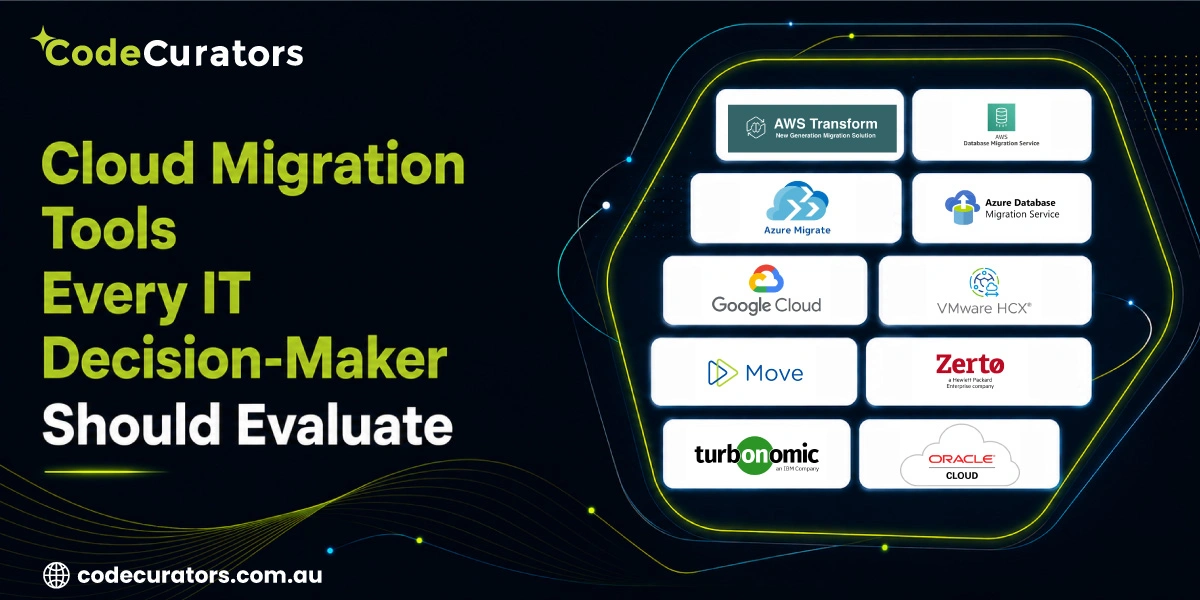
1. AWS Transform MGN

Server migrations from physical, virtual, and other cloud environments into AWS are made easier with the help of AWS Transform MGN. It minimizes disturbance and lowers migration risks by using continuous block-level replication to keep source servers in sync with AWS until the final cutover.
The service helps IT teams expedite large-scale modernization projects while preserving application compatibility by automating numerous difficult migration operations. For end-to-end project management, it also interfaces with AWS migration and modernization services. For businesses preparing extensive AWS migrations that need reliable replication, little downtime, and smooth workload transitions, AWS Transform MGN is a great option.
2. AWS Database Migration Service

Businesses may move databases to AWS safely and with little downtime by using the AWS Database Migration Service. Businesses can switch between different database engines while preserving data integrity because of its support for both homogeneous and heterogeneous database migrations. Continuous data replication, schema conversion, and support for continuous synchronization during migration are all features of the service.
This facilitates quicker project completion and lessens operational disruption. AWS DMS is used by many companies that provide the best cloud migration services to make difficult database modernization projects easier. For AWS database migration projects that require high availability, flexibility, and effective data transfer across several environments, it is especially well suited.
3. Azure Migrate

This is one of the most popular cloud migration tools used for evaluating and moving servers, databases, web apps, and virtual desktops. To simplify planning, it effortlessly maps app dependencies, finds IT assets, and assesses migration readiness. Additionally, the platform helps businesses optimize cloud spending before migration by offering comprehensive cost projections, right-sizing advice, and performance data.
An organized and effective migration workflow is made possible by Azure Migrate’s smooth integration with Microsoft’s migration ecosystem. For companies running Microsoft-based setups that need thorough evaluation, precise planning, and an easy transfer into Azure with lower operational risks, it is the perfect answer.
4. Azure Database Migration Service

Azure Database Migration Service reduces application downtime and streamlines database migrations to Azure. Both online and offline migration scenarios are made possible by its support for SQL Server, MySQL, PostgreSQL, Oracle, and a number of other database platforms. Organizations can lower migration risks by using the service, which automates migration activities, creates readiness reports, and finds compatibility issues prior to execution.
In order to guarantee effective deployment, built-in monitoring features offer visibility during the migration process. Azure Database Migration Service provides a dependable, scalable, and effective migration experience with minimal business impact, making it especially appropriate for enterprises modernizing enterprise databases and shifting workloads onto Azure.
5. Google Cloud Migration Center

A centralized platform for identifying workloads, apps, and infrastructure prior to cloud migration is offered by Google Cloud Migration Center. It automatically creates migration recommendations based on workload characteristics, examines dependencies, and inventory current assets. To help users make well-informed decisions, the platform also provides tools for infrastructure sizing, migration planning, and cost estimation.
These insights assist companies in setting workload priorities, creating practical migration plans, and preventing needless cloud costs. Because it streamlines enterprise-scale cloud transformation initiatives by combining discovery, assessment, planning, and optimization into a single solution, Google Cloud Migration Center is particularly helpful for companies preparing Google Cloud migrations.
6. VMware HCX

Workloads may be moved between VMware environments with the least amount of disturbance thanks to VMware HCX, a hybrid cloud migration platform. It offers flexibility for companies with a variety of infrastructure requirements by supporting live migration, bulk migration, replication-assisted migration, and scheduled workload transfers.
Network extension, which enables virtual machines to maintain IP addresses during migration without requiring application modification, is one of its best features. Additionally, disaster recovery planning and automated migration orchestration are supported by VMware HCX. For businesses running VMware hybrid cloud setups that need smooth workload mobility, little downtime, and easy migration between private and public clouds, it is a great option.
7. Nutanix Move

A migration tool called Nutanix Move makes it easier to move virtual machines from VMware ESXi, Hyper-V, and other compatible hypervisors into Nutanix AHV. The platform minimizes human configuration duties, assesses migration readiness, provides network mapping, and automates migration operations.
Additionally, it minimizes downtime for production workloads by enabling non-disruptive data synchronization prior to cutover. To enhance project visibility and execution, Nutanix Move offers centralized monitoring and migration status reporting. It provides a dependable, effective, and simple method for large-scale virtual machine migration operations, which is especially advantageous for companies updating infrastructure and using Nutanix environments.
8. Zerto

Zerto is well known for its disaster recovery and continuous data replication capabilities, which also help with cloud migration projects. Organizations may move workloads with no downtime and data loss thanks to its nearly real-time replication between environments. Businesses may verify migration success prior to production cutover with the platform’s capabilities for migration testing, failover, rollback, and automatic recovery.
Zerto is appropriate for intricate multi-cloud systems because it connects with significant public and private cloud providers. For companies moving mission-critical applications that need robust disaster recovery protection, high availability, and business continuity throughout the migration process, it is a great option.
9. IBM Turbonomic

IBM Turbonomic focuses on intelligent cloud migration planning by assisting businesses in determining the best locations for workloads in terms of both cost and performance. It assesses infrastructure utilization, suggests workload scaling, forecasts resource requirements, and determines the optimal deployment locations across hybrid and multi-cloud systems using AI-powered analytics.
These suggestions ensure application performance after migration while reducing overprovisioning. Additionally, Turbonomic guarantees continuing operational efficiency by supporting continual optimization after workloads are operating in the cloud. It is especially helpful for businesses looking to optimize cloud costs in conjunction with strategic migration planning and infrastructure modernization projects.
10. Oracle Cloud Migrations

Organizations may find, evaluate, and move workloads into OCI with the help of Oracle Cloud Migrations. The software used by a cloud migration service provider in Australia facilitates migration planning with comprehensive assessments, analyses virtual machines, and assesses infrastructure preparedness. Additionally, it provides replication features that minimize cutover downtime by synchronizing workloads prior to final migration.
Before execution starts, organizations gain better insight into the complexity of the migration and the resources needed. Businesses looking for organized planning, dependable replication, and a more seamless transition with less operational disturbance are ideally suited for Oracle Cloud Migrations when transferring Oracle databases, virtual workloads, and apps into OCI.
Key Features to Compare When Evaluating Cloud Migration Tools
➥ Workload Compatibility
Check to determine if the tool supports your virtual machines, physical servers, databases, operating systems, apps, and containerized workloads. Broad compatibility guarantees that business-critical systems can be moved without necessitating significant infrastructure changes, minimizes compatibility problems, and lowers migration complexity.
➥ Migration Approach
Select technologies that facilitate rehosting, replatforming, refactoring, and repurchasing applications, among other migration options. Organizations can match cloud adoption with business objectives, application requirements, financial restrictions, and long-term modernization plans thanks to flexible migration options.
➥ Automation Capabilities
Check for automation features including automated cutover, workload replication, migration wave planning, and infrastructure discovery. Large-scale cloud migration initiatives benefit from automation’s reduction of manual labor, minimization of human mistakes, acceleration of migration deadlines, and improvement of consistency.
➥ Security and Compliance
Data encryption, identity and access control, compliance reporting, and audit trails are all important security aspects. These features assist regulatory compliance, safeguard confidential company information, and give governance and security auditors full visibility into migration operations.
➥ Downtime Requirements
Make a cloud migration tools comparison according to scheduled cutover time, rollback capabilities, continuous replication, and live migration support, in addition to minimizing operational disruptions and guaranteeing a speedy recovery in the event of migration problems. Solutions that minimize downtime help in maintaining business continuity.
➥ Cost and Licensing
In addition to data transfer fees, cloud infrastructure costs, implementation costs, and training needs, evaluate subscription or usage-based pricing. Organizations can choose the best cloud migration tools that provide long-term value within budget by having a thorough understanding of the total cost of ownership.
➥ Monitoring and Reporting
Dashboards for monitoring performance, finding faults, tracking migration progress, and evaluating risks are all provided by effective migration solutions. Throughout the migration process, executive-level reports provide stakeholders with a comprehensive picture of the project’s state and assist teams in making well-informed decisions.
➥ Vendor Support
Comprehensive documentation, training materials, and quick technical help are provided by cloud migration service providers. These tools assist businesses in swiftly resolving problems and guaranteeing a successful cloud migration, from planning to post-migration optimization.
Also Read: AI Integration Strategy Consulting: A Complete Guide for Business Leaders
Cloud-Native vs Third-Party Migration Tools
✧ When to Choose Cloud-Native Tools
Organizations that have committed to a single cloud provider, like AWS, Microsoft Azure, or Google Cloud, are best suited for cloud-native migration tools. With built-in compatibility, native security controls, and streamlined migration processes, these cloud migration consulting services are designed to work with their respective cloud platforms. While adhering to the provider’s best practices, they frequently offer automated discovery, workload assessment, replication, and monitoring capabilities.
Businesses employing cloud migration consulting services can streamline operations and maximize the capabilities of their chosen cloud platform. For companies looking for consumption-based pricing, easier management, and quicker deployment, a cloud migration agency helps you. Cloud-native technologies usually offer the most effective and economical solution if your migration strategy concentrates on a single cloud ecosystem with minimal multi-cloud requirements.
✧ When to Choose Third-Party Tools
For businesses managing hybrid or multi-cloud systems, where workloads must shift between several cloud providers and on-premises infrastructure, third-party migration tools are perfect. These technologies simplify complicated corporate projects by providing vendor-neutral evaluations, increased platform compatibility, and modern migration options.
They frequently offer rollback capabilities, disaster recovery, continuous replication, live migration, and centralized monitoring across several environments. For business-critical apps that need flexible migration strategies and little downtime, third-party technologies are very helpful. Additionally, they support future cloud expansion, infrastructure modernization, and long-term operational flexibility while assisting organizations in avoiding vendor lock-in.

Ready to Select the Right Cloud Migration Tool?
Cloud migration is a complicated process, and that’s why firms require robust tools that help to streamline the process. Having an ideal tool enhances performance, productivity, and release accuracy. Multiple cloud migration tools are used by cloud migration experts, each having specific pros.
A few tools focus on data relocation, while some focus on cloud migration and automation. Before you choose any of the tools from the list of cloud migration tools, it’s necessary to measure your migration requirements. For a better decision, talk with a cloud migration service provider in Australia.
DON'T FORGET TO SHARE


15 Best Cloud Migration Companies in Australia for Business Leaders
Discover the 15 best cloud migration companies in Australia helping businesses improve scalability, security, and achieve cloud transformation…

Cloud Migration Cost in Australia: A Complete Pricing Guide for 2026
Explore cloud migration cost in Australia for 2026, including pricing factors, cost breakdowns and practical tips to plan…
How Can We Help You?
Drop your details below and our engineering team will reach out within one business day.