Australian companies are accelerating cloud migration to modernise IT infrastructure, improve scalability, strengthen resilience, and support virtual transformation. According to Gartner, Australian public cloud spending is expected to reach A$33.6 billion in 2026, up 17.9% from 2025. As firms manage growing data volumes, distributed apps, and evolving customer expectations, the demand for secure, scalable, and cost-efficient cloud infrastructure continues to increase.
However, migrating critical workloads to the cloud requires careful planning, technical expertise, security controls, and effective cost management. Selecting the right cloud migration services partner can assist businesses in measuring their current environments, choosing suitable cloud platforms, minimising errors, and optimising performance after migration.
A reliable cloud migration service provider in Australia also supports apps and data migration while addressing compliance & business continuity requirements. Read the guide to know 15 leading cloud application migration service providers in Australia to help business leaders compare their industry expertise and success rate, and support when selecting a suitable technology partner.
What Is a Cloud Migration?
The process of transferring databases and IT infrastructure from current environments to the cloud is referred to as cloud migration. While a cloud migration company manages technical planning and execution, cloud migration consulting services assist with readiness assessment, migration planning, workload transfers, and disruption minimisation. Organisations can use platforms like AWS, Microsoft Azure, Google Cloud Platform (GCP), or private cloud environments to implement public, private, hybrid, or multi-cloud models.

Why Australian Businesses Are Investing in Cloud Migration
◈ Reduce IT Infrastructure Costs
By reducing reliance on physical infrastructure, cloud migration agencies can help businesses save capital costs and make better use of their resources. Organisations can more closely match infrastructure costs to actual workload requirements.
◈ Improve Business Scalability
Businesses can scale their computer resources to meet demand thanks to cloud infrastructure. Without making significant investments in new physical infrastructure, organisations can better handle seasonal workloads, support growth, and manage unexpected traffic spikes.
◈ Strengthen Security and Business Continuity
Modern cloud environments offer automated backups, security controls, and disaster recovery capabilities. By taking these steps, Australian cloud migration solution providers can increase system availability, safeguard important data, recover from disruptions more quickly, and improve overall operational resilience.
◈ Support AI and Digital Transformation
AI, analytics, and automation projects can be supported by the infrastructure that cloud migration produces. Companies can create adaptable technology foundations that allow virtual transformation.
How We Selected the Best Cloud Migration Companies in Australia
➞ Cloud migration expertise- We evaluated the experience of providers in organising and carrying out intricate cloud migrations involving workloads, data, infrastructure, and applications.
➞ AWS, Azure and Google Cloud capabilities– To ensure broad platform capabilities, we assessed expertise in AWS, Microsoft Azure, and Google Cloud.
➞ Migration methodology– To reduce risks and disruption, we examined structured approaches for assessment, planning, migration, testing, deployment, and optimisation.
➞ Industry experience– We considered the best cloud migration services provider who had relevant industry experience and was familiar with the workloads, operational needs, and compliance requirements.
➞ Cloud certifications and partnerships– We evaluated partnerships and certifications from AWS, Microsoft, and Google Cloud as indicators of technical proficiency.
➞ Security and compliance expertise- Throughout the migration process, we evaluated proficiency in data protection, access control, encryption, monitoring, regulatory compliance, and cloud security.
➞ Application modernisation capabilities- We searched for a cloud migration agency that provides cloud-native development, containerization, microservices, re-platforming, and refactoring for modern application environments.
➞ Data migration experience- We evaluated expertise in safely moving databases and important business data while preserving availability, accuracy, integrity, and minimal downtime.
➞ Client portfolio and case studies- We have gone through client portfolios and case studies to check the experience of providers, project outcomes, industries, and migration challenges.
➞ Managed cloud services– We checked cloud migration services for Australian companies that offered post-migration cloud cost control, infrastructure management, performance optimisation, security management, and continuous monitoring.
➞ Post-migration support- We checked top cloud migration companies’ ongoing technical support capabilities that they offer companies for resolving problems and maintaining cloud operations.
➞ Australian market presence- We chose migration cloud services companies with well-established Australian operations and familiarity with regional business, industry, legal, and technological requirements.
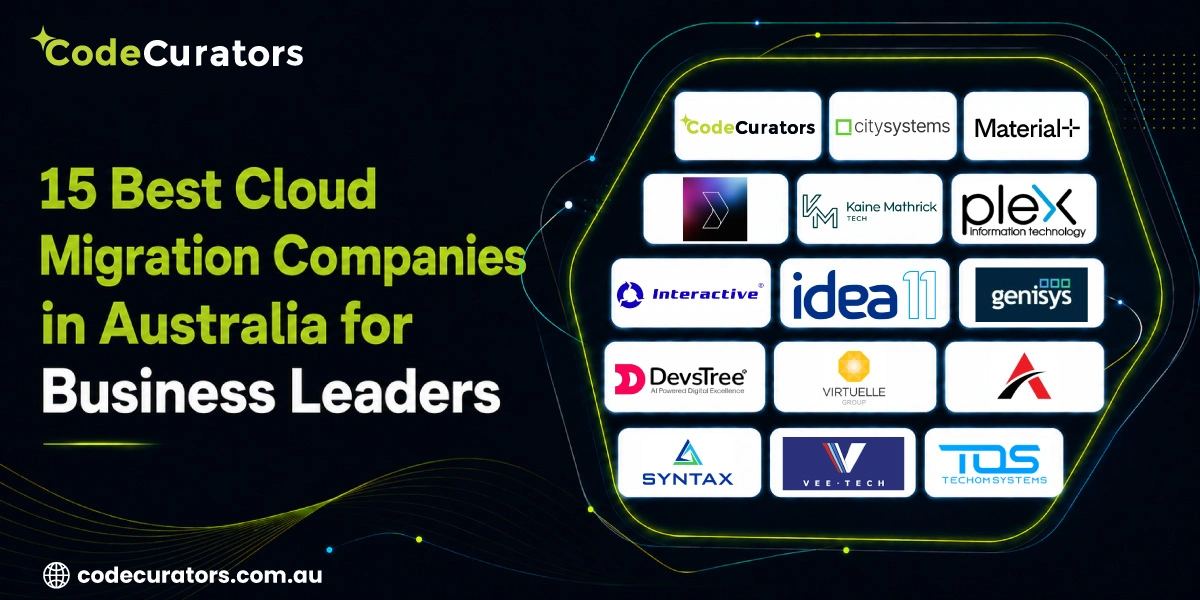
15 Best Cloud Migration Companies in Australia
1. Code Curators Australia

Code Curators, the cloud migration service provider in Australia, offers cloud migration and consulting services focused on assisting companies in modernising their data and infrastructure. Planning, safe application and workload transfers, and continuous cloud management are all included in its cloud migration strategy. The firm focuses on increasing scalability, operational efficiency, security, and performance. Code Curators also publishes guidelines on Australian cloud migration costs, strategies, and migration considerations.
| Sr. No. | Key Points | Services Provided |
|---|---|---|
| 1 | Founded Year: 2024 | Cloud Consulting |
| 2 | Employees: 2 – 10 | AI Development |
| 3 | Location: Australia | AI Chatbot Development |
| 4 | LinkedIn: View Profile | LLM Development |
| 5 | Website: Code Curators | AI Consulting |
2. City Systems
City Systems provides Australian companies with end-to-end cloud migration services. Before creating a migration roadmap, the organisation conducts readiness assessments that address workloads, dependencies, licensing, and risks. Additionally, its managed services help businesses maintain continuity and maximise the return on their cloud investment. It includes monitoring, security, backup, disaster recovery, cost optimisation, and performance management after migration.
| Sr. No. | Key Points | Services Provided |
|---|---|---|
| 1 | Founded Year: 2002 | Cloud Consulting |
| 2 | Employees: 11 – 50 | Cyber Security |
| 3 | Location: Australia | IT Strategy & Advisory |
| 4 | Website: View Website | Microsoft 365 & Cloud |
3. Material Plus

Material Plus helps Australian businesses move infrastructure, data, and apps with more control and less disturbance. Its methodology starts with a readiness assessment to determine the need for migration and assess current capabilities. The cloud migration service providers assist with thorough migration planning and execution, paying close attention to performance, security, and compatibility. Beyond migration, it offers cloud cost optimisation and FinOps, DevOps and automation, site reliability engineering, security and compliance, and continuous training and support. Material Plus is appropriate for companies looking to move to the cloud while also improving operational effectiveness, dependability, governance, and cost control.
| Sr. No. | Key Points | Services Provided |
|---|---|---|
| 1 | Founded Year: 1973 | Cloud Consulting |
| 2 | Employees: 1,001 – 5,000 | Data Analytics |
| 3 | Location: Australia | Brand Strategy |
| 4 | LinkedIn: View Profile | Market Strategy |
4. Dynamic Business Technologies
For Australian companies looking to make safe and effective moves from their current IT environments, Dynamic Business Technologies provides end-to-end cloud migration solutions. They provide services like Infrastructure assessment, migration planning, execution, and post-migration optimisation. Our main goals of migration strategy are reducing disruption, improving scalability, increasing data security, and assisting with disaster recovery. Dynamic Business Technologies also offers cloud migration consulting. With over 20 years of experience, it delivers customised solutions, cost-effectiveness, security and compliance, and long-term operational support.
| Sr. No. | Key Points | Services Provided |
|---|---|---|
| 1 | Founded Year: 2006 | Cloud Consulting |
| 2 | Employees: 11 – 50 | AI Business Solutions |
| 3 | Location: Australia | Cyber Security |
| 4 | LinkedIn: View Profile | Managed IT Services |
5. KM Tech
For Australian companies looking to update their on-premises infrastructure and migrate to more adaptable cloud environments, KM Tech offers cloud migration services. The team aims to minimise disruption to business operations while planning and carrying out migrations. Planning, risk assessment, data migration, and user training are all included in their migration process. Additionally, KM Tech offers SharePoint migration capabilities and focuses its cloud services on assisting companies in implementing scalable infrastructure.
| Sr. No. | Key Points | Services Provided |
|---|---|---|
| 1 | Founded Year: 2010 | Cloud Consulting |
| 2 | Employees: 51 – 200 | Infrastructure Consulting |
| 3 | Location: Australia | Cyber Security |
| 4 | LinkedIn: View Profile | IT Managed Services |
6. Plex IT

Plex IT helps companies move their infrastructure and workloads to the cloud by offering Microsoft Azure services. Its cloud migration service aims to ease the shift to Azure while allowing businesses to take advantage of modern cloud capabilities, scalability, and flexibility. Additionally, it allows the development of applications. Plex IT is useful for companies looking to move their current systems while laying the groundwork for modern data, analytics, and application workloads in Azure.
| Sr. No. | Key Points | Services Provided |
|---|---|---|
| 1 | Founded Year: 2009 | Cloud Consulting |
| 2 | Employees: 2 – 10 | Website Design |
| 3 | Location: Australia | Cyber Security |
| 4 | LinkedIn: View Profile | Managed IT Services |
7. Interactive
Interactive offers cloud adoption, lowering migration risks, managing expenses, and migration services. The company’s multi-cloud strategy allows enterprises to choose cloud platforms based on their workloads, applications, security needs, and business objectives. Interactive supports both public and private cloud environments and emphasises fixed-price migration options. Its cybersecurity capabilities support the integration of security into its cloud approach. Organisations looking for flexible migration strategies instead of a one-size-fits-all cloud transition will find Interactive especially useful.
| Sr. No. | Key Points | Services Provided |
|---|---|---|
| 1 | Founded Year: 1998 | Cloud Consulting |
| 2 | Employees: 501 – 1,000 | Data Centre Services |
| 3 | Location: Australia | Cyber Security |
| 4 | LinkedIn: View Profile | Cloud Management |
Also Read: Cloud Migration Tools Every IT Decision-Maker Should Evaluate
8. Idea11
Idea11 offers cloud migration implementation and consulting services centred on safe, organised, and business-oriented cloud adoption. After migration, Idea11 offers continuing maintenance, optimisation, monitoring, and support. This cloud migration services company has expertise in both application migration and infrastructure modernisation. The company’s main goals are to reduce downtime, manage expenses, and improve security. It assists Australian companies in setting up cloud environments that support long-term expansion and innovation.
| Sr. No. | Key Points | Services Provided |
|---|---|---|
| 1 | Founded Year: 2009 | Cloud Consulting |
| 2 | Employees: 51 – 200 | Azure Consulting Services |
| 3 | Location: Australia | IT Infrastructure |
| 4 | LinkedIn: View Profile | Data & AI Services |
9. Genisys

Genisys offers Assessment, planning, architecture, migration execution, security, and continuous optimisation. Additionally, Genisys offers multi-cloud management, cloud cost optimisation, security and compliance, and modernisation of cloud applications. Before creating an appropriate target architecture, its migration methodology assesses the data, applications, and infrastructure that are already in place. Genisys helps businesses looking for scalable, secure cloud environments while preserving business continuity during migration.
| Sr. No. | Key Points | Services Provided |
|---|---|---|
| 1 | Founded Year: 2001 | Cloud Consulting |
| 2 | Employees: 11 – 50 | Managed Infrastructure Services |
| 3 | Location: Australia | Cloud Computing Consulting Services |
| 4 | LinkedIn: View Profile | Cyber Security Services |
10. DevsTree Australia

Moving apps, data, and infrastructure from legacy environments into modern cloud platforms is the main goal of DevsTree Australia’s cloud migration services. Business continuity, data integrity, security, and performance are given top priority throughout the migration process. Prior to planning and architectural design, the migration process starts with assessment and strategy development. Businesses can lower operational risks, modernise legacy systems, and create scalable cloud environments that can handle future expansion.
| Sr. No. | Key Points | Services Provided |
|---|---|---|
| 1 | Founded Year: 2013 | Cloud Consulting |
| 2 | Employees: 11 – 50 | Web Development |
| 3 | Location: Australia | Mobile App Development |
| 4 | LinkedIn: View Profile | AI & ML |
11. Virtuelle Group

Virtuelle Group offers cloud migration and consulting services to Australian businesses wishing to update their IT infrastructure. They provide Infrastructure management, business continuity, disaster recovery, cloud security, cloud advisory, and private and hybrid cloud solutions. Virtuelle Group assists companies in creating cloud environments that strike a balance between scalability, performance, privacy, and compliance by concentrating on governance and regulatory issues. Their comprehensive transformation strategy is intended to integrate cloud investments with measurable business outcomes.
| Sr. No. | Key Points | Services Provided |
|---|---|---|
| 1 | Founded Year: 2013 | Cloud Consulting |
| 2 | Employees: 51 – 200 | AI Integration |
| 3 | Location: Australia | Cyber Security |
| 4 | LinkedIn: View Profile | Penetration Testing |
12. Musca Tech

Musca Tech supports companies all over Australia with cloud migration services. The company can assist companies in moving from on-premises infrastructure, and it supports public, private, and hybrid cloud models. Throughout the migration process, Musca Tech, the cloud migration company, places a strong emphasis on safe data handling, minimal disruption, scalability, and cost-effectiveness. The company offers its services to companies looking for a customised, managed approach to infrastructure modernisation and cloud adoption.
| Sr. No. | Key Points | Services Provided |
|---|---|---|
| 1 | Founded Year: 2007 | Cloud Consulting |
| 2 | Employees: 2 – 10 | Business Consulting |
| 3 | Location: Australia | Data Migrations |
| 4 | LinkedIn: View Profile | Cyber Security |
13. Syntacks

Syntacks offers cloud migration advisory services with the goal of assisting businesses in evaluating, organising, and getting ready for complicated cloud transitions. Syntacks supports cloud platforms like AWS and has specialised experience with mission-critical enterprise applications. Before transferring crucial workloads to the cloud, this methodical approach can assist organisations in identifying risks. It helps estimate migration costs, plan data movement, and establish suitable strategies.
| Sr. No. | Key Points | Services Provided |
|---|---|---|
| 1 | Founded Year: 2009 | Cloud Consulting |
| 2 | Employees: 2 – 10 | AI Application Modernisation |
| 3 | Location: Australia | Business Analytics |
| 4 | LinkedIn: View Profile | Website Development |
14. Veetech
Veetech, which specialises in Microsoft Azure and AWS, offers cloud migration services to Australian SMEs. While assisting organisations to improve scalability, security, performance, and cost-effectiveness, the company concentrates on preserving business continuity. Additionally, Veetech supports Microsoft 365 adoption, continuous IT management, and cloud-enabled backup and disaster recovery. Businesses transferring workloads from on-premises infrastructure or creating hybrid environments can benefit from its migration offering. The company offers cloud migration services along with more extensive IT and cybersecurity capabilities to businesses throughout Australia.
| Sr. No. | Key Points | Services Provided |
|---|---|---|
| 1 | Founded Year: 2017 | Cloud Consulting |
| 2 | Employees: 2 – 10 | Managed IT Services |
| 3 | Location: Australia | Cyber Security |
| 4 | LinkedIn: View Profile | Networking |
15. Techom Systems
Cloud migration services from TECHOM Systems are intended to assist Australian companies in transferring IT assets to cloud environments with the least amount of disruption. Along with security, cost optimisation, integration, and continuous technical support, the company highlights its expertise in Microsoft cloud migration. Its cloud-first services aim to decrease reliance on conventional infrastructure while increasing scalability, flexibility, operational efficiency, and business continuity. Additionally, TECHOM Systems bases its services on customised migration strategies and offers advice from qualified experts. For companies looking for a managed cloud transition backed by continuous optimisation and technical expertise, they could be the best choice.
| Sr. No. | Key Points | Services Provided |
|---|---|---|
| 1 | Founded Year: 2013 | Cloud Consulting |
| 2 | Employees: 51 – 200 | Digital Transformation |
| 3 | Location: Australia | Managed IT Services |
| 4 | LinkedIn: View Profile | Cyber Security |
Cloud Migration Services Businesses Should Look For
✦ Cloud Readiness Assessment
Before the migration starts, a cloud readiness assessment assesses your current IT setup. Companies are able to recognise potential hazards, compatibility issues, security flaws, and technical constraints early on. Establishing reasonable migration priorities and resource needs is another benefit of a thorough assessment. With this foundation, organisations can create a migration strategy that is aligned with their operational and business goals.
✦ Cloud Migration Strategy and Roadmap
An organised approach to cloud migration offers a clear path from the current infrastructure to the intended cloud environment. Companies should plan scalable architectures based on workload requirements, choose suitable cloud models, and establish migration priorities. Cost estimation, resource planning, risk mitigation, and timeline development are further features of the best cloud migration services.
✦ Application Migration
Transferring business applications from current environments to appropriate cloud platforms is known as application migration. Rebuilding applications can sometimes be a better long-term strategy. In order to ensure that applications continue to be reliable and functional during the transition, an appropriate migration strategy takes into account application dependencies, performance requirements, compatibility, security, and business criticality.
✦ Data Migration
To safely transfer databases and business data to the cloud, data migration calls for careful planning. To avoid data loss or corruption, services should include database migration, data mapping, validation, cleansing, and integrity checks. Crucial information must be kept safe throughout migration. To reduce downtime, businesses should also schedule rollback options, backup processes, and migration windows. When data is migrated properly, essential information is guaranteed to remain accurate, secure, consistent, and accessible.
✦ Legacy Application Modernisation
Businesses can change outdated systems that might restrict scalability, performance, or integration capabilities with the help of legacy application modernisation. Cloud migration companies are able to evaluate legacy applications and decide whether they need to be rebuilt, modernised, or containerised. Cloud-native development allows applications to utilise modern cloud capabilities, while the adoption of containers and microservices can increase flexibility and deployment efficiency. By using this strategy, organisations can lower their technical debt, improve application performance, and build a stronger foundation for upcoming digital projects.
✦ Cloud Security and Compliance
Security and compliance are 2 elements that must be considered in the initial phase. Security monitoring, vulnerability management, identity and access management, encryption for data in transit and at rest, and suitable access controls should all be included in services. Additionally, providers must take industry-specific regulations and data protection obligations into account. A robust security framework protects cloud workloads, lowers the risk of unauthorised access, preserves visibility, and facilitates continuous compliance.
✦ Cloud Optimisation and Managed Services
Cloud optimisation helps businesses maintain performance and control costs after migration. Services should include infrastructure and application performance monitoring, resource optimisation, cloud cost management, and capacity planning. Managed technical support also provides access to specialised expertise when needed. Cloud optimisation allows firms to improve cloud efficiency, avoid unnecessary spending, and maintain reliable workloads.
How to Choose the Right Cloud Migration Company in Australia
➥ Check Their Cloud Platform Expertise
Select the best cloud migration services company that has demonstrated proficiency with the main cloud platforms, such as Google Cloud, Microsoft Azure, and AWS. To ensure a more seamless and efficient migration, their platform experience should align with your current infrastructure, applications, workloads, and future technology plans.
➥ Evaluate Relevant Industry Experience
Give preference to companies who have managed workloads and regulatory requirements unique to their industry. Examine their prior migration initiatives for companies with comparable operational, security, compliance, and scalability requirements. Experience in the relevant industry can lower risks and guarantee that the migration complies with sector-specific requirements.
➥ Review Their Migration Methodology
Check out a methodical approach that addresses planning, assessment, migration, testing, and optimisation. Identifying dependencies, controlling risks, reducing downtime, and upholding accountability throughout the project are all made easier with a well-defined process. Additionally, providers should outline deadlines, responsibilities, milestones, and backup plans.
➥ Understand Their Security Approach
Examine the provider’s methods for safeguarding data and cloud workloads both during and after deployment. Data security, access control, compliance, encryption, monitoring, and disaster recovery should all be included in their strategy. Robust security procedures reduce vulnerabilities and promote business continuity.
➥ Review Their Cloud Certifications and Partnerships
Verify if the company has the necessary Google Cloud, Microsoft Solutions Partner, and AWS certifications. Technical proficiency and access to well-established cloud ecosystems can be demonstrated by these credentials. Additionally, verify that their certifications correspond with the migration requirements and cloud platform of your choice.
➥ Ask About Post-Migration Support
Evaluate the continuing support capabilities offered by cloud migration consulting companies. Seek out cloud migration consulting services, cost management, security monitoring, performance optimisation, and managed cloud services. In addition to enhancing cloud performance and reducing operating costs, ongoing support helps in maintaining reliable workloads.
Common Cloud Migration Challenges Businesses Should Prepare For
➞ Unexpected migration costs – Additional costs for data transfer, licensing, and infrastructure upgrades may be included in a cloud migration.
➞ Application compatibility issues – After being migrated to a cloud environment, some applications might not operate correctly.
➞ Data security risks – Critical data may be vulnerable to security flaws during migration. Data can be protected during migration with the help of encryption, access controls, and security monitoring.
➞ Downtime – Access to databases may be disrupted by poorly organised migration operations. Downtime can be reduced with phased migration, testing, backups, and well-thought-out cutovers.
➞ Legacy system dependencies – It may be challenging to move legacy apps straight to the cloud. Identifying these helps businesses decide whether to migrate, modernise, or replace.
➞ Skills gaps – Companies with limited internal resources might require specialised training or assistance from seasoned cloud specialists.
➞ Compliance requirements – Companies need to make sure that migrated workloads and data continue to comply with industry, regulatory, and privacy requirements.
➞ Poor cloud architecture – Without proper architectural planning, moving current infrastructure to the cloud may cause issues with performance, security, scalability, and dependability.
➞ Cloud cost overruns – When businesses provide unnecessary resources or neglect to track consumption, cloud costs may rise.
➞ Post-migration performance issues – After migration, applications could face resource limitations, slower response times, or connectivity issues.
Also Read: Cloud Migration Cost in Australia: A Complete Pricing Guide for 2026
Cloud Migration Trends Australian Business Leaders Should Watch
✧ Multi-Cloud and Hybrid Cloud Adoption
In order to increase flexibility, resilience, and workload placement, Australian companies are increasingly implementing multi-cloud and hybrid environments. Organisations can address specific performance, security, compliance, and business requirements while lowering reliance on a single cloud provider by utilising multiple cloud platforms together with private infrastructure.
✧ AI-Ready Cloud Infrastructure
Companies are setting up cloud environments to handle expanding AI workloads, such as advanced analytics, machine learning, and generative AI. Scalable computing, high-performance data platforms, effective storage, and robust governance are all necessary for AI-ready infrastructure. In order to facilitate the adoption of AI in the future, organisations are updating their cloud architectures.
✧ Application Modernisation
As companies replace legacy systems with scalable, cloud-native architectures, application modernisation continues to be a top priority for cloud migration. In addition to helping organisations lower their technical debt and promote innovation, strategies like containerization, microservices, and application refactoring can enhance flexibility, performance, deployment speed, and integration.
✧ Cloud FinOps and Cost Optimisation
Cloud FinOps is becoming more and more crucial as businesses want more visibility and control over their cloud expenditures. It helps monitor consumption, find inefficient resources, optimise workloads, and increase cost-effectiveness without sacrificing application performance. Businesses are combining engineering and operational procedures with financial management.
✧ Cloud Security and Zero-Trust Architecture
Stronger security measures based on zero-trust principles are being driven by the adoption of cloud computing. Companies are strengthening threat detection, encryption, continuous monitoring, and identity verification in cloud environments. These procedures support compliance, lower the risks of unauthorised access, and safeguard sensitive workloads.
✧ Increased Automation in Cloud Migration
Automated tools can minimise human error, speed up migration times, increase consistency, and lessen manual labour. As a result, companies can maintain operational control while handling complicated cloud transitions more effectively.

Ready to Plan Your Cloud Migration with the Right Experts?
Let your business experience a smooth cloud transition with the best cloud migration companies. Determine your cloud readiness, migration requirements, build a secure & scalable migration strategy, and receive expert support from planning to post-migration. Compare skilled cloud migration service providers to collaborate with the right partner whose skills match your business goals, security needs, and long-term growth.
DON'T FORGET TO SHARE

Cloud Migration Cost in Australia: A Complete Pricing Guide for 2026
Explore cloud migration cost in Australia for 2026, including pricing factors, cost breakdowns and practical tips to plan…

Cloud Migration Tools Every IT Decision-Maker Should Evaluate
Explore key cloud migration tools IT leaders should evaluate to reduce risks and ensure a secure, cost-effective cloud…
How Can We Help You?
Drop your details below and our engineering team will reach out within one business day.